Know the instrument
before the surgeon asks.
In the OR, nobody waits for you to look it up. 356 pages of numbered illustrations, comparison charts, mnemonics and memory tricks turn instruments, sterile technique, back table setups and sutures into pictures you'll recognize on the tray. Every chapter is mapped to the CST exam, so you always know which part of the exam you're studying.
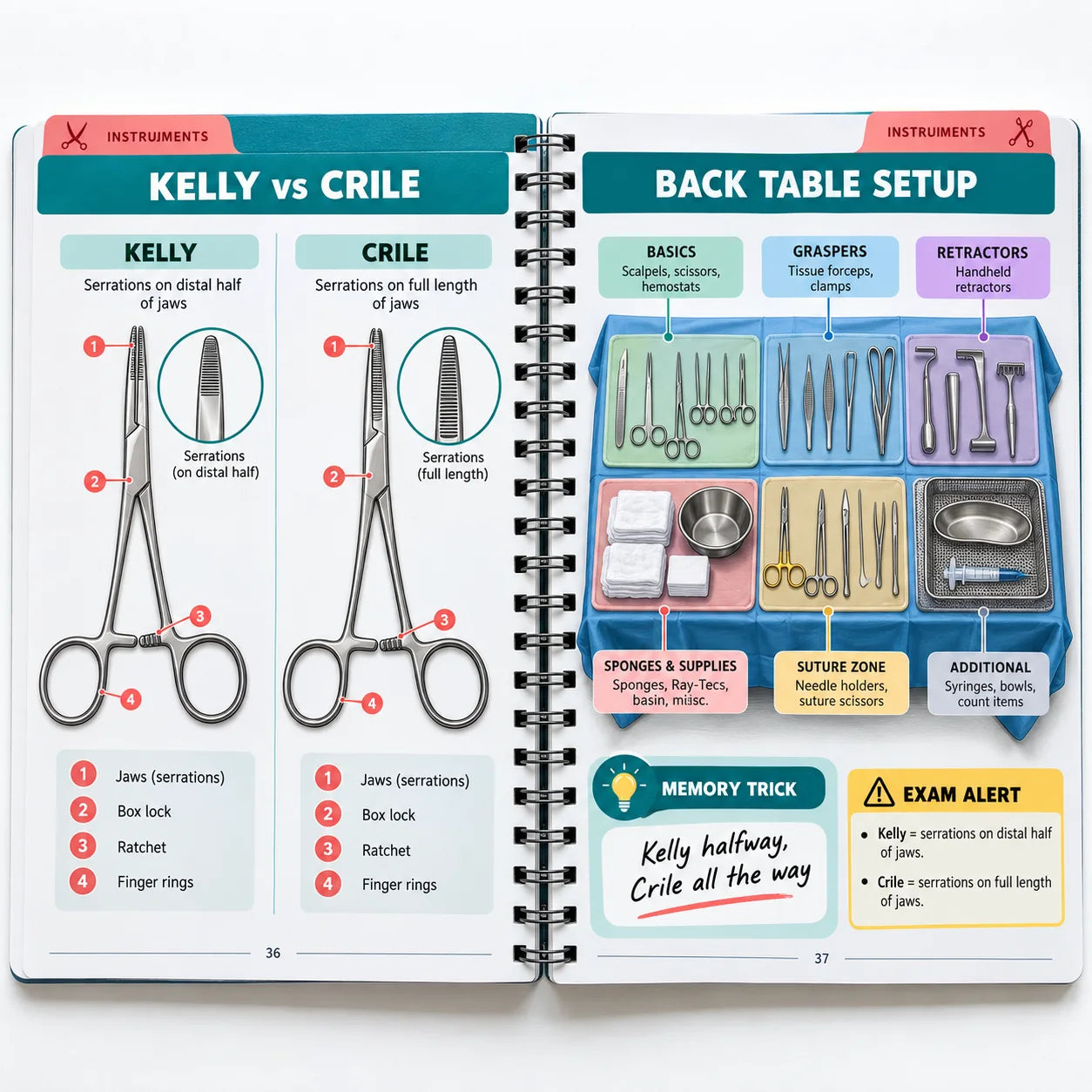
Not notes. A visual system.
Every spread uses the same five tools, so your brain always knows where to look.
Whatever semester you're in, you start today.
Learn it right the first time
Anatomy, microbiology, pharmacology and the instrument families, drawn so you understand them instead of cramming them the night before the test. Especially if it's been years since your last science class.
Clip it to your badge
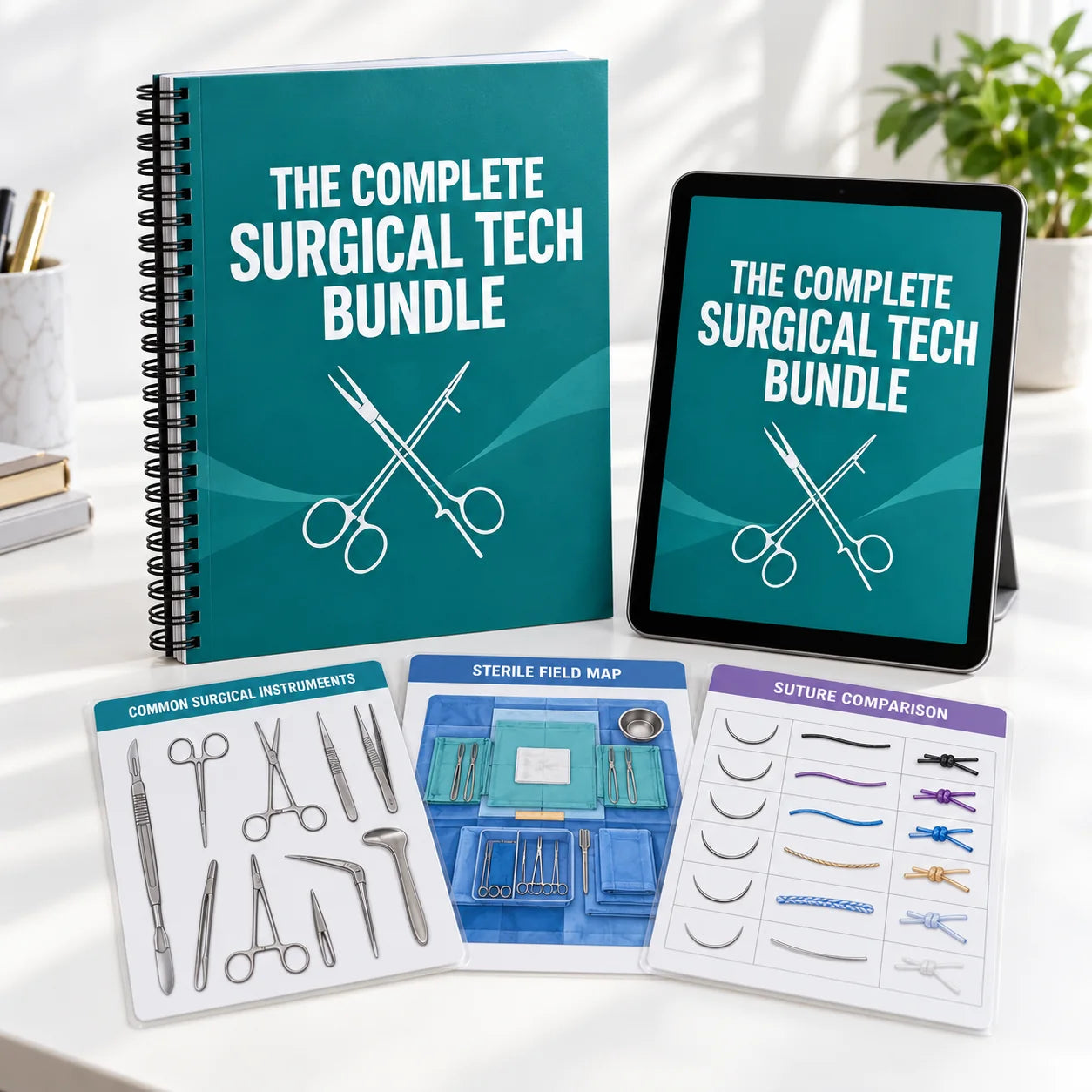
Case prep and intra-op pages, plus the 3 badge cards for your rotations: instruments by category, sterile field rules, and a suture & needle guide.
Review the whole program in four weeks
The cram sheets and exam alerts condense your whole program into the distinctions the CST keeps asking, with a plan for your last four weeks.
Before the case. During the case. After the case.
65% of the CST is perioperative care: what you do before, during and after a surgical case. So the bundle follows a case from start to finish, the same way you'll live it in the OR. Basic science (20%) and ancillary duties (15%), the rest of the exam, get their own chapters too.
Before the case
Case prep, opening your sterile supplies, and setting up the back table and the Mayo stand, drawn step by step so you set up the same way every time.
During the case
Anticipating the next step of the procedure, passing instruments, counts, specimens and keeping the sterile field sterile. It's the biggest part of the CST, so it gets the most pages, including 48 pages of procedures by specialty, drawn step by step.
After the case
Breaking down the setup, sharps and waste, pre-cleaning instruments for sterile processing, and resetting the room for the next case. The part most students leave for last, and it's on the exam too.
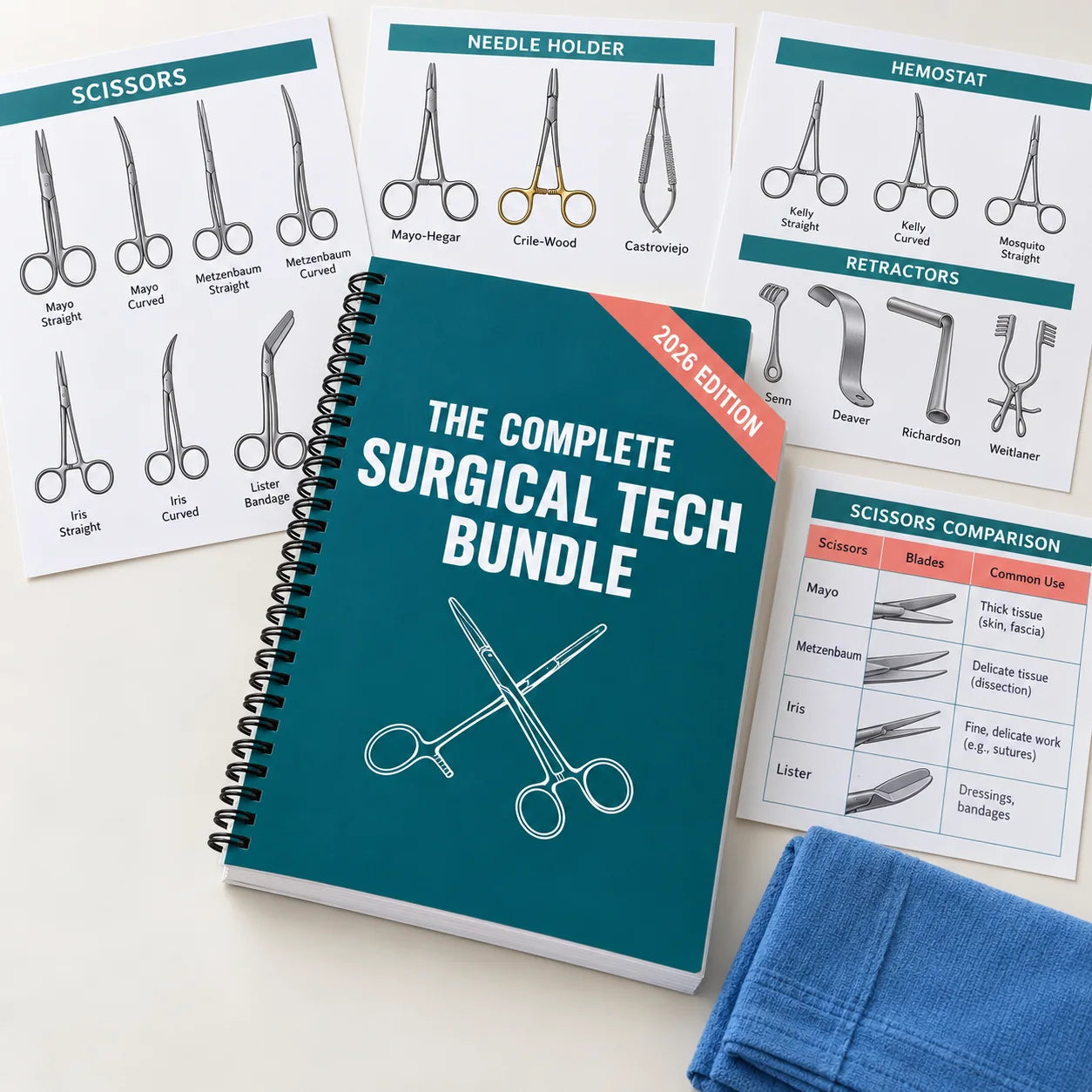
The instruments, drawn and named.
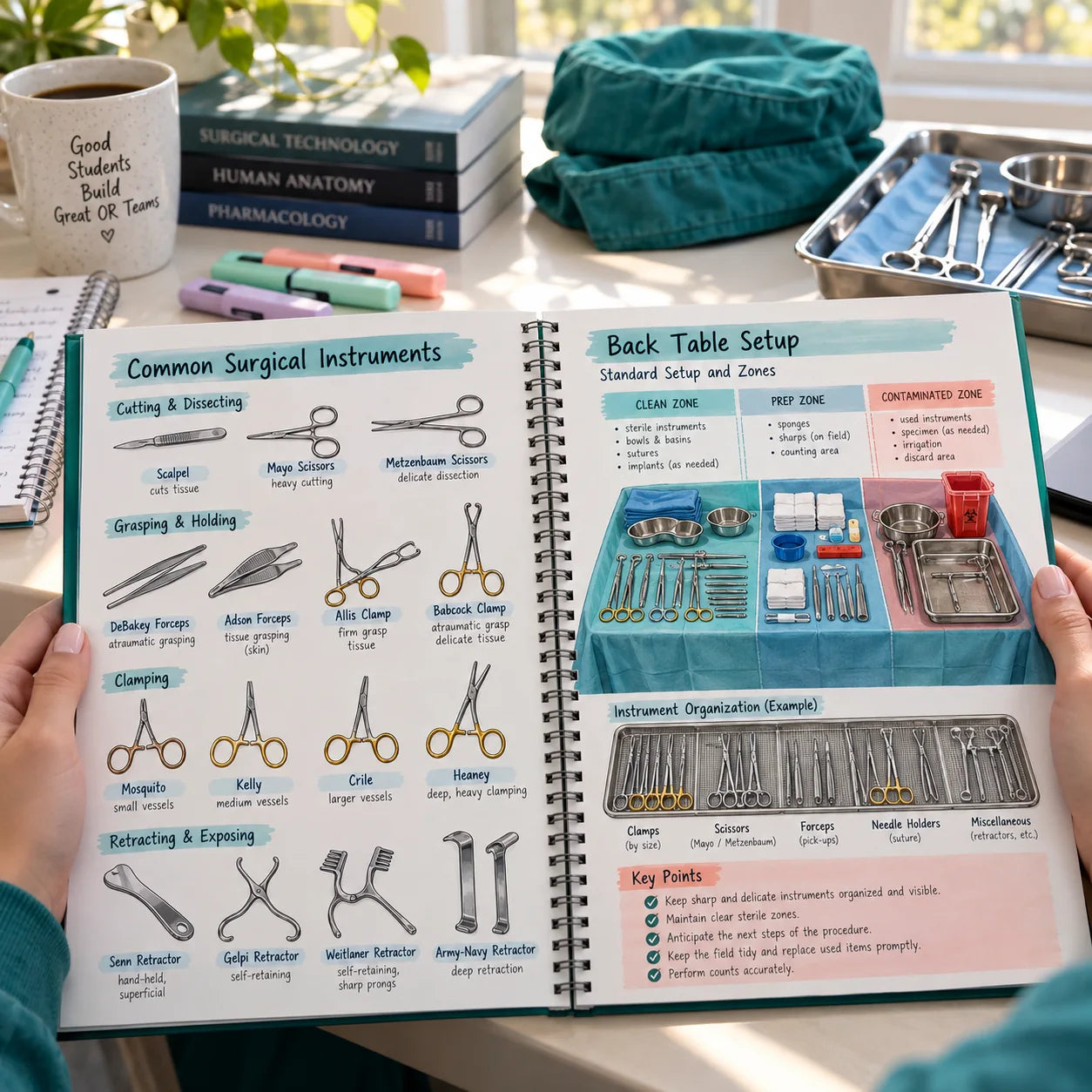
Hundreds of instruments look alike until you see them side by side. Here the ones you'll be asked for are drawn with their name, their job and their family, so you recognize them on the tray before anyone asks.
- Cutting, clamping, grasping, retracting, suturing and suction instruments, sorted by function
- A name, a job and a clear drawing for each instrument you need to know
- Look-alikes compared side by side, like Kelly vs Crile
- Where each one goes on the back table and the Mayo
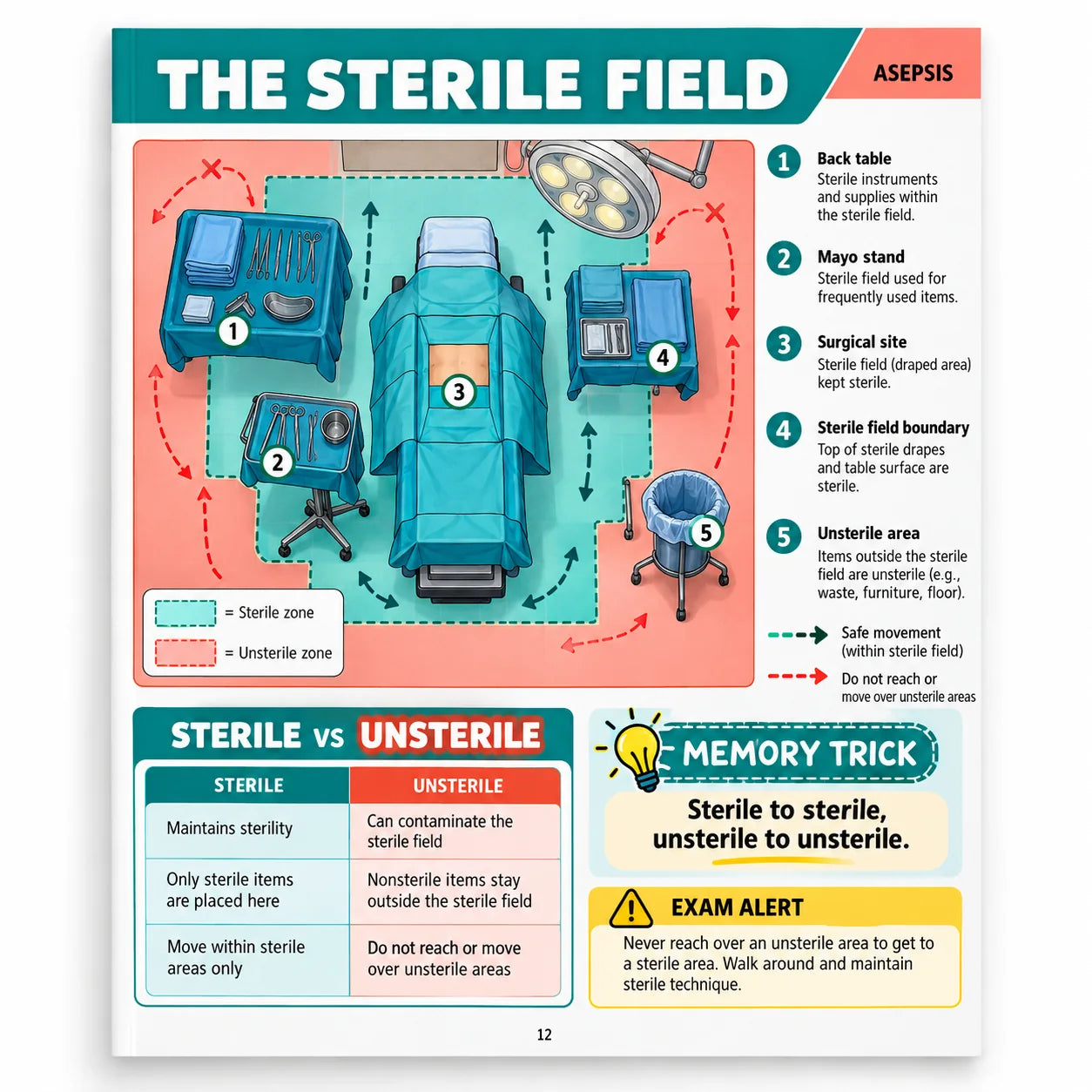
The sterile field, drawn as a map.
Sterile technique is a set of rules you have to follow without thinking, with a surgeon waiting. Here the sterile field is a drawing with clear borders, so you can see what's sterile, what isn't, and what happens when the two meet.
- The sterile field drawn as a map, borders marked
- Sterile vs unsterile in one comparison chart
- Opening sterile supplies, step by step
- Steam, ethylene oxide, hydrogen peroxide gas plasma and more, side by side, plus chemical and biological indicators
Set it up the same way every time.
A good setup makes the whole case run smoother. Here each setup is a drawing you can copy, with every instrument in its place, so setting up becomes a habit instead of a guess.
- The back table drawn from above, every zone labeled
- The Mayo stand in the order of use
- Case prep and opening, step by step
- Transfer, positioning, skin prep and the time out, in the order they happen
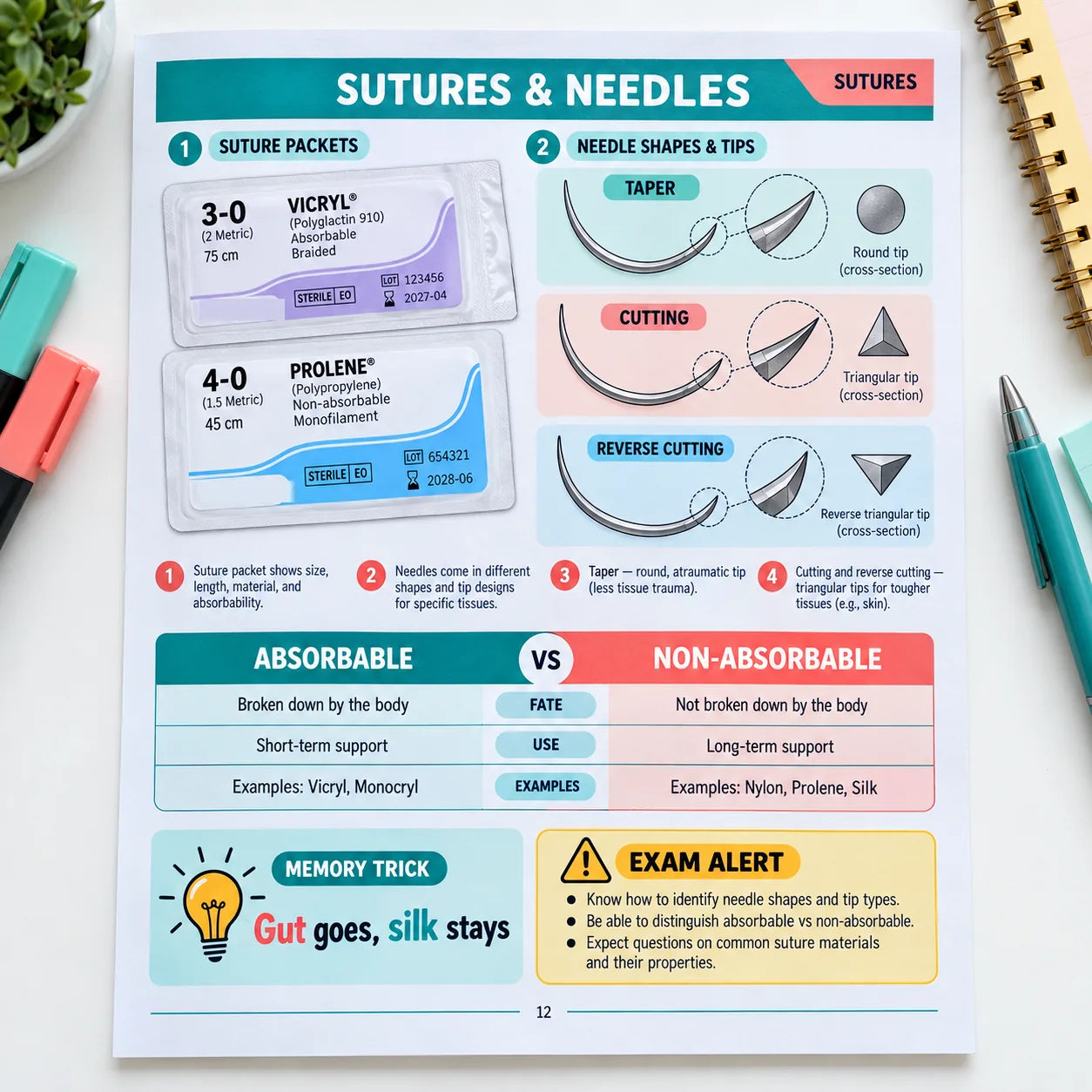
The sutures, when and why.
Suture names, materials and needles blur together fast. Here they're sorted into charts, absorbable or not, natural or synthetic, so you can reach for the right one before it's asked for.
- Absorbable vs non-absorbable in one comparison chart
- Needle types drawn and labeled
- Loading and passing the needle holder, step by step
- Hemostasis: mechanical, thermal and chemical, with the hemostatic agents you'll prepare
Every count, at the right moment.
During the case everything has an order: what you count and when, how you pass, how you handle a specimen. Here each of those is a sequence of drawings, so you can follow the case one step at a time.
- The counts: what, when and who. Before the incision, before closing a cavity within a cavity, before wound closure, at skin closure and at every permanent relief
- Instrument passing, drawn hand to hand
- Specimen handling, from the field to the label
- Draping, drawn in sequence
- Drains, catheters and dressings: what to prepare and when
The last weeks before the CST, on 20 pages.
The instruments, sterile field rules, sutures and case steps the CST asks about most, condensed into cram sheets you can reread in your last weeks.
- Instruments by category on one page
- Sterile field rules and sutures at a glance
- Basic science essentials: anatomy, microbiology, pharmacology
- A 4-week CST plan: what to review each week, and when to switch to practice questions
- The one-page CST map: every chapter linked to the three content areas of the exam
Your textbooks explain it. These pages show it.
The drawing, the color and the layout are the mnemonic: you remember the page, so you remember the answer.
- Mapped to the CST exam, with a one-page exam map
- Drawn by a certified surgical technologist, CST
- Updated every year; ebook buyers get the new edition free
Inside the bundle.
The whole program, in one bundle.
Full table of contents
On your iPad, on your desk, or both.
Instant download, hyperlinked index
Works in GoodNotes, Notability and any PDF app. Free update every year.
Full color, lay-flat, 8.5 × 11
Printed on thick paper with colored tabs, laminated badge cards included. Free US shipping.
120 flashcards and 3 badge cards.
Instruments, sutures, sterile technique and basic science: the drawing on one side, the answer on the other. Print them, ring them, or swipe them in GoodNotes. The badge cards fit your reel for clinical rotations: instruments by category, sterile field rules, and a suture & needle guide.
- Printable PDF, 4 per page
- Digital version with hyperlinked index
- Badge cards laminated with the spiral-bound edition
Get 10 real pages, free.
Kelly vs Crile, the sterile field as a map, the back table setup, absorbable vs non-absorbable sutures, the counts step by step, and one case followed from start to finish: before, during and after. Study them tonight and decide with the pages in your hands.
How it stacks up.
| Feature | This bundle | Review book | Online review course | Q-bank app |
|---|---|---|---|---|
| Every topic built around a drawing | ✓ | Some figures | Mostly video & text | ✗ |
| Organized in the order of a surgical case | ✓ | Varies | Varies | ✗ |
| Mnemonics and memory tricks in every chapter | ✓ | Varies | Varies | Varies |
| Timed practice questions | Pair with one | ✓ | ✓ | ✓ |
| Print + iPad | ✓ | Print or ebook | Screen | Screen |
| Badge cards for clinical rotations | ✓ | ✗ | ✗ | ✗ |
| Free ebook updates | ✓ | New edition $ | Varies | With subscription |
| Price | $29.99 | From $39.99 | From $120 | From $15.99/month |
Studying tonight, not next week.
Pick your format
eBook, spiral-bound or both. Secure checkout, no account to create, no subscription.
Open it anywhere
Your download link arrives by email. Open it in GoodNotes, Notability or any PDF app, or print the pages you need.
The book comes to you
Your full-color spiral-bound copy and laminated badge cards ship free in the US, with tracking.
Everything, one price.
- 356 illustrated pages, 11 chapters, mapped to the CST exam
- The surgical case followed step by step: before, during and after
- 60 pages of surgical instruments, drawn and named
- 48 pages of procedures by specialty: the steps, the instruments and the setup for each
- 120 printable & digital flashcards
- 3 badge cards for clinical rotations
- CST cram sheets
- Free yearly update for the ebook
- Free US shipping on spiral-bound
The questions students ask before buying
Will this be enough to pass the CST?
It covers the content the CST draws on: perioperative care before, during and after the case, ancillary duties, and the basic science behind them (anatomy, microbiology and pharmacology), with the distinctions the exam keeps asking flagged as exam alerts. But the CST is 175 questions in 4 hours, so you also need practice answering under time. Pair the bundle with timed practice questions: the pages help you remember, the questions teach you to apply.
Does it cover the surgical procedures?
Yes. Almost half the CST is about what happens during the case, and many questions ask about a specific procedure: which instrument, which step, which approach. Chapter 10 covers procedures by specialty in 48 pages, each with the steps in order, the key instruments and the setup, so you can anticipate what the surgeon needs next.
Does it include practice tests?
No, and we'd rather tell you up front. The bundle is the content: illustrated, organized and easy to review. For timed practice, use the question bank your program recommends or the official CST practice exams sold by the NBSTSA. The two work together: pages to remember, questions to apply.
It's been years since I studied. Can I keep up?
Yes, that's who the drawings are for. Every page starts from the picture, not the jargon, and the basic science chapters explain the anatomy, microbiology and pharmacology you need for the OR without assuming you remember high school biology.
My CST is in a few weeks. Is it too late?
No. Start with the cram sheets and the one-page CST map, use the exam alerts in each chapter to find your weak spots, and follow the 4-week plan: it tells you what to review each week and when to switch to practice questions.
I'm retaking the CST. Will this help?
Yes. Start from your score report: it shows how you did in each content area. Reopen the chapters behind your weakest one, drill practice questions on it, and finish with the cram sheets the week before. You can sit the CST up to 3 times a year; check the NBSTSA site for the current retake rules.
Will it help with the TS-C?
Yes, the content overlaps: instruments, sterile technique, sutures, case prep and the basic science behind them are the same whichever exam you take. The bundle is mapped to the CST, so check the TS-C content outline from the NCCT and focus on the chapters that match it. Before you choose, check which credential your state and the hospitals you want to work for accept: some ask for the CST by name.
Does my state require certification?
More than a dozen states have laws on who can work as a surgical technologist, including Connecticut, Georgia, Idaho, Illinois, Indiana, Massachusetts, Nevada, New Jersey, New York, Oregon, Pennsylvania, South Carolina, Tennessee, Texas and Virginia. Most accept national certification such as the CST, some also accept graduation from an accredited program, and Colorado, North Dakota and Washington require registration. Laws change and have exceptions, so check your state and your future employer before you plan your exam date.
Can I use it during clinical rotations?
Yes. The instrument, back table and sterile field pages, and the 3 badge cards (instruments by category, sterile field rules, suture & needle guide), are the quick reference you'll want in your locker and on your badge reel. It's a study guide, not a clinical manual, so always follow your preceptor, the surgeon's preference card and your facility's policies.
Is it useful before my program starts?
Yes. Chapters 1, 2 and 3 (anatomy, physiology & surgical pathology; microbiology, infection control & wound healing; pharmacology, anesthesia & meds on the field) are the best way to get ahead before your program, especially if it's been a while since your last science class.
My program uses Alexander's (or another textbook). Will it still work?
Yes. The bundle is organized by the exam, not by a textbook, so it works alongside Alexander's or whatever your program assigns. Think of it as the pictures your textbooks are missing.
Is it up to date?
Yes. This is the 2026 edition, mapped to the current NBSTSA CST content outline (in effect since January 2023). We update it every year, and ebook buyers get the new edition free.
Which apps does the ebook work with?
Any PDF app: GoodNotes, Notability, Apple Books, Adobe, Xodo. The index is hyperlinked so you can jump between chapters. You can also print any page.
Is the spiral-bound printed in color?
Yes, full color, 8.5 × 11 inches, lay-flat spiral binding, colored tabs, and the 3 badge cards laminated. Ships free in the US.
What if it isn't for me?
Email us within 30 days and we refund you. No questions, no forms.
Ready to walk into the CST knowing every step of the case?
356 illustrated pages, 11 chapters, 120 flashcards, 3 badge cards. Instant download. 30-day guarantee.
$29.99 · instant access