Cold calls. Curved finals.
Every 1L rule, drawn.
Your professor calls your name and asks for the rule of a case you read at 1 a.m. Then finals: a long fact pattern, a curve, and the clock running. 332 illustrated pages turn Civ Pro, Contracts, Torts, Property, Con Law and Crim Law into rules you can see at a glance, from orientation to finals.
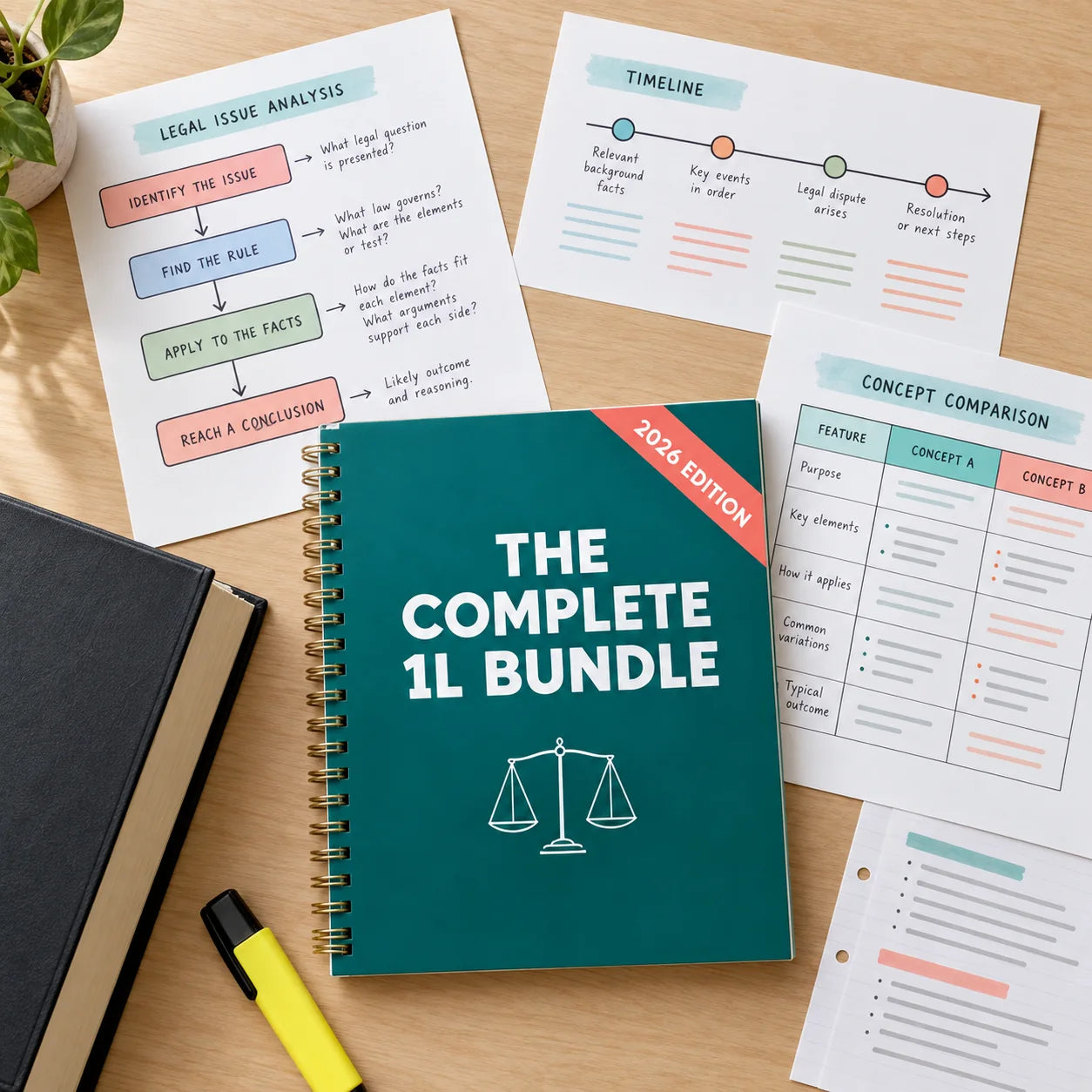
Not notes. A visual system.
Every spread uses the same five tools, so your brain always knows where to look, even after forty pages of casebook.
Wherever you are in 1L, you start today.
Walk into orientation ready
In fall 2025, 42,817 students started 1L (ABA), and most of them were told to relax the summer before. Relax, and read one short page a day: how to brief a case, how IRAC works, what personal jurisdiction even means. It won't replace your casebook or your professor. It gives you the map before the reading starts.
One page before every class
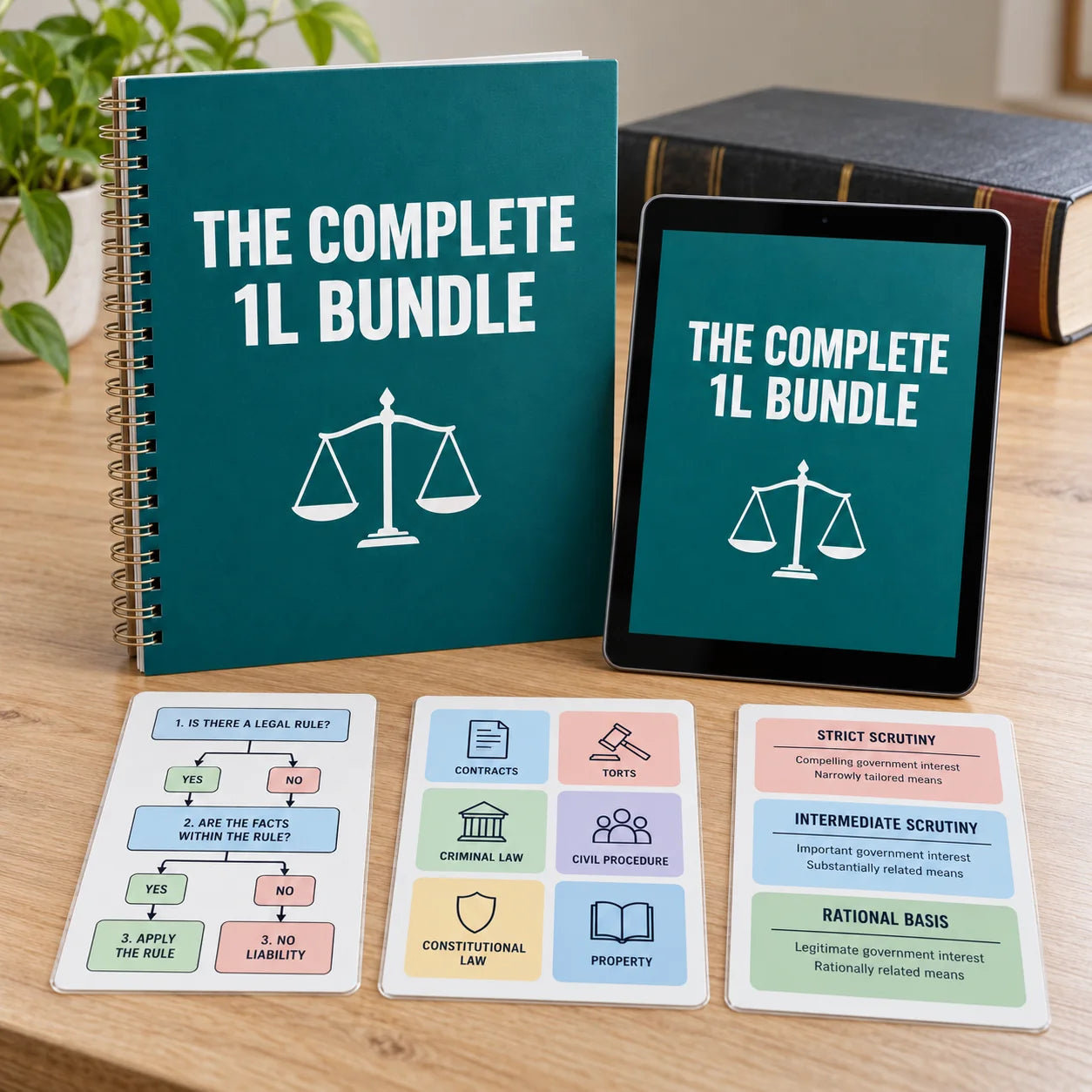
Every topic fits on a short page you can read before class, so a cold call finds you with the rule already in your head. When outlining season comes, use the pages as the model for your own outline. Plus the 3 quick-reference cards: the personal jurisdiction flowchart, contract formation & defenses, and levels of scrutiny.
Review, don't relearn
24 pages of cram sheets and attack outlines, a 3-week plan and a one-page exam map for every subject tell you what to reread and when to switch to practice exams. The same rules come back later on the bar: this is the foundation, not bar prep.
Spot the issue. State the rule. Apply it to the facts.
On a 1L exam, knowing the rule is never the whole answer: the points go to the student who finds the issue buried in the facts and applies the rule to them. That's IRAC. So every topic in the bundle follows the same path: where the issue hides in a fact pattern, the rule reduced to its elements, then how to apply it, with a mini fact pattern drawn on the page.
Spot the issue
Every topic starts with the facts that should make you stop: a defendant from another state, a promise nobody wrote down, a gift of land "but if" something happens. Drawn so you learn what the issue looks like in the facts before you learn its name.
State the rule
The rule reduced to its elements, with the look-alikes side by side on a comparison chart, so you can write it in two lines instead of retelling the whole case. The mnemonic sits right next to it.
Apply it to the facts
Every topic ends on a mini fact pattern drawn on the page: which facts meet which element, and where the counterargument lives. That's where 1L exams give the points. Where a rule has a majority and a minority view, the page shows both, so you can write the one your professor taught.
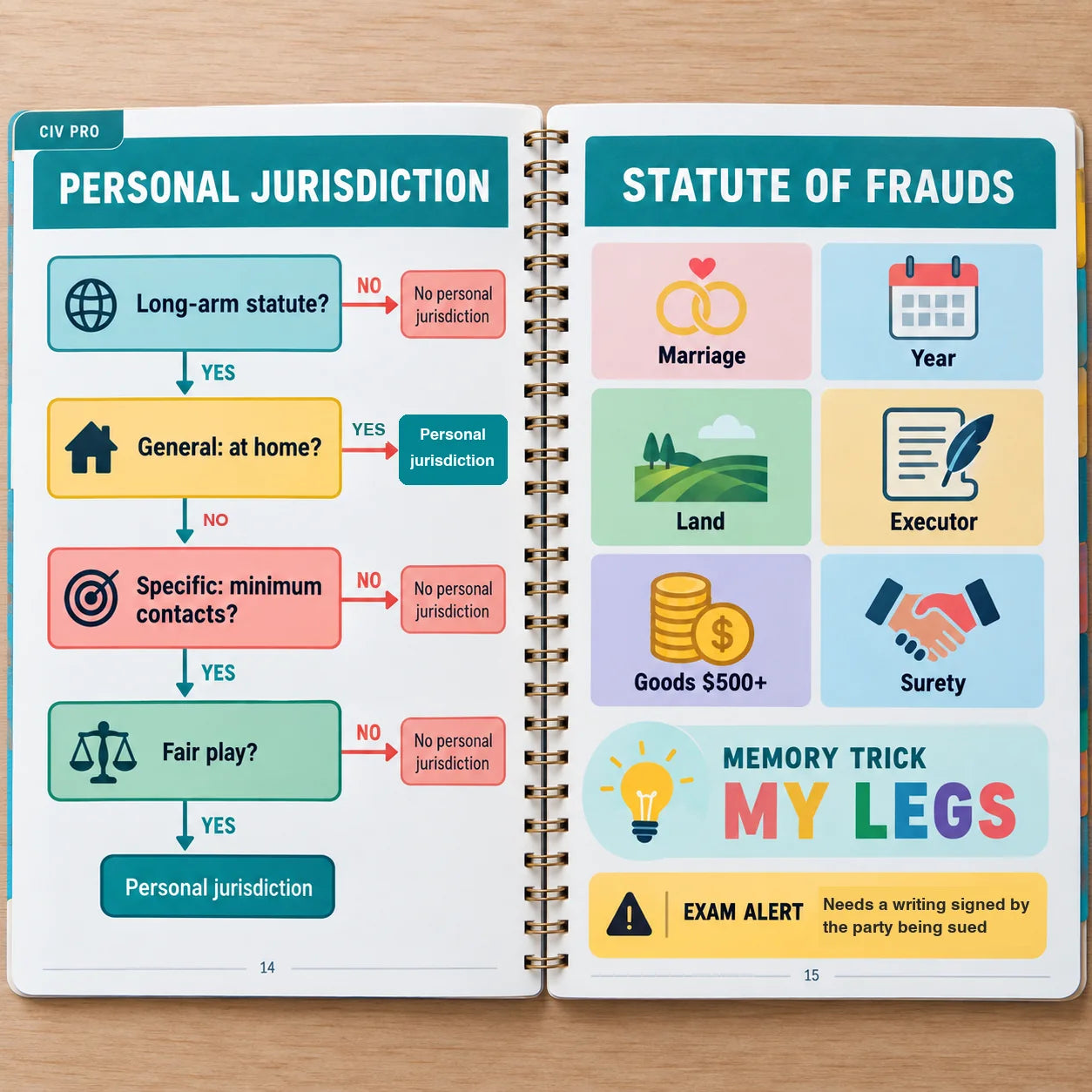
Can this court hear this case? One picture.
Personal jurisdiction is where many 1Ls get lost in the first month: International Shoe, then the cases that refine it, each one a separate story. Here the test is drawn as one flowchart, so every case lands as a step on the same path.
- Personal jurisdiction drawn as one flowchart: the long-arm statute first, then due process, with general ("at home") and specific jurisdiction (minimum contacts, relatedness, fair play) and the traditional bases: presence, domicile, consent
- Subject-matter jurisdiction (federal question; diversity with complete diversity and more than $75,000), supplemental jurisdiction, removal and venue, side by side so you stop mixing them up
- Exam alert: personal jurisdiction, subject-matter jurisdiction and venue are three separate questions. Answer all three.
- Pleading to judgment, Erie and preclusion in Civil Procedure II, 28 pages of their own
Offer, acceptance, and the promise nobody wrote down.
Was there a contract, and can anyone get out of it? Here formation and defenses are drawn in the order you check them, so a fact pattern with a handshake deal stops being a trap.
- Offer, acceptance and consideration drawn as one path, with the mirror image rule and UCC 2-207's battle of the forms side by side
- The defenses on one chart, including the Statute of Frauds and the contracts it covers
- Exam alert: check first whether the deal is a sale of goods. If it is, UCC Article 2 governs (mixed goods-and-services deals: predominant purpose test), with the common law filling the gaps.
- Performance, breach, remedies and UCC Article 2 in Contracts II, 28 pages of their own
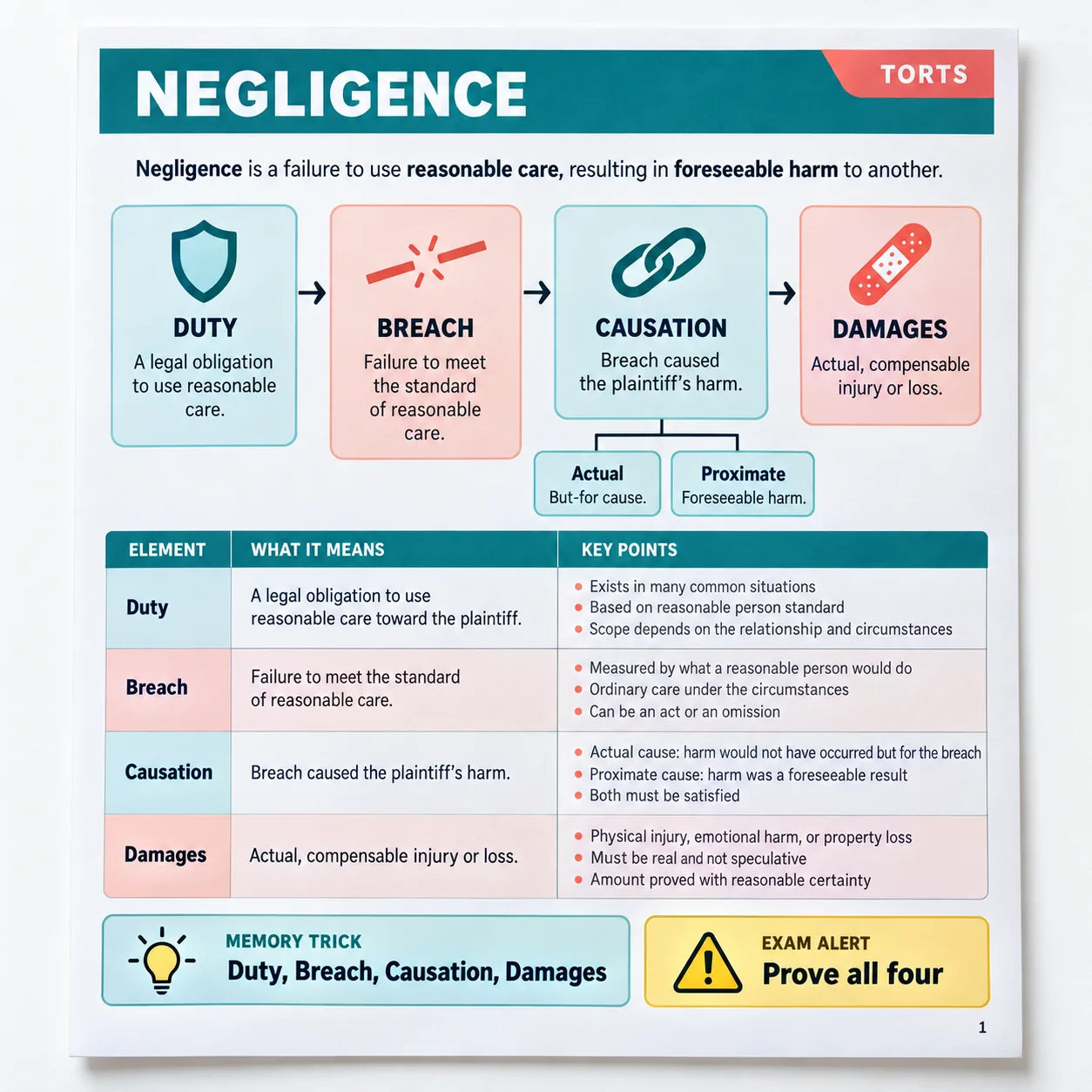
Four elements. Miss one, lose the claim.
Negligence shows up again and again on Torts exams, often hidden inside a story about something else. Here each element is drawn with the facts that prove it and the facts that break it, so you walk through every fact pattern the same way.
- The intentional torts side by side: the elements and the defenses for each
- Negligence drawn element by element, with a mini fact pattern for each one
- Causation drawn as two questions: actual cause and proximate cause
- Strict liability, products liability, defamation and privacy in Torts II, 24 pages of their own
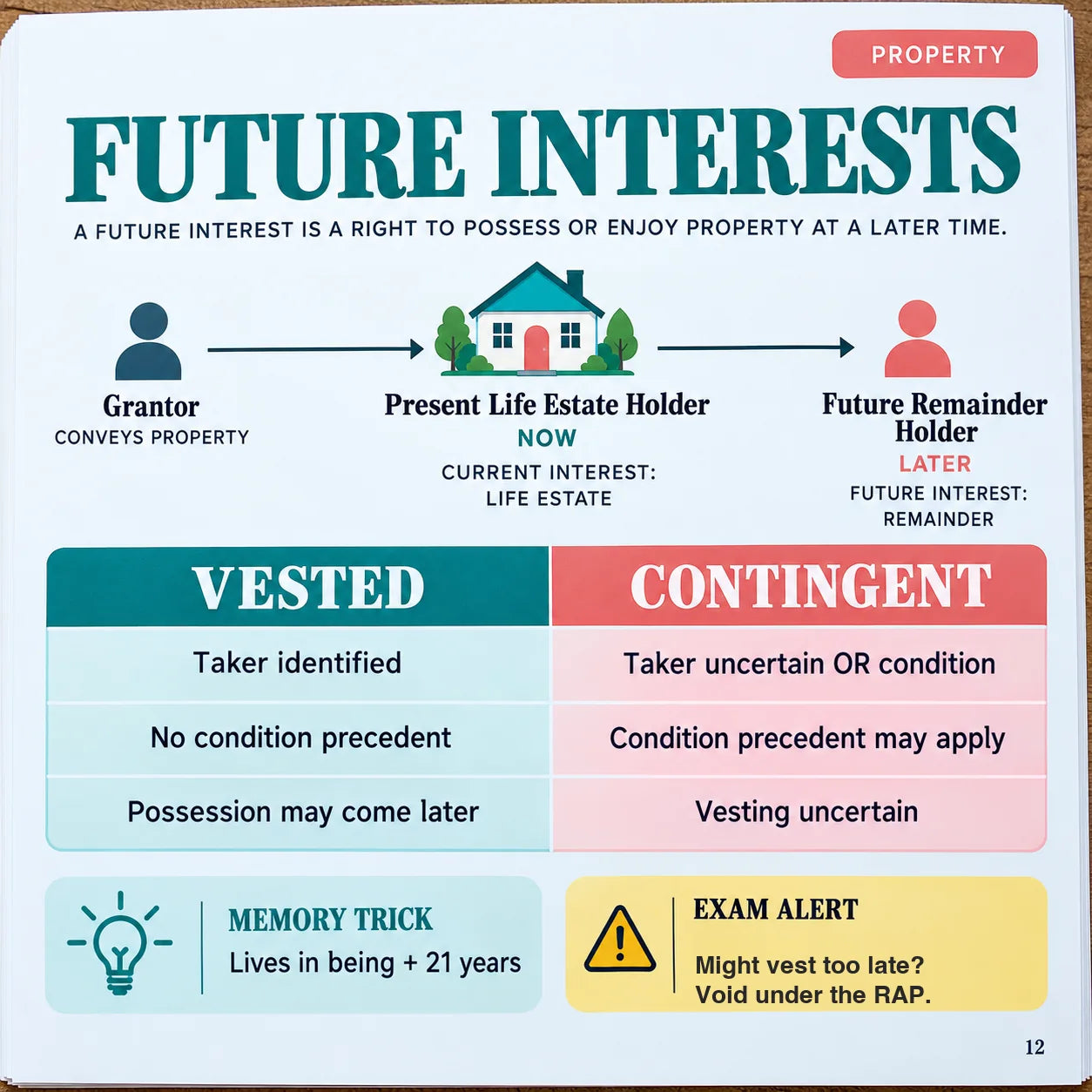
Future interests you can finally see.
Fee simple, remainders, executory interests, the Rule Against Perpetuities: the chapter so many 1Ls dread. Here every estate is drawn as a timeline, so you can see who holds what, and when it passes.
- Present estates and future interests drawn as timelines, with the look-alikes side by side
- The Rule Against Perpetuities drawn step by step
- Adverse possession, element by element
- Where a rule has a majority and a minority view (adverse possession, the RAP, recording acts), the page shows both. On the exam, write your professor's.
- Landlord-tenant, conveyancing, servitudes and recording acts in Property II, 28 pages of their own
Name the right. Pick the test. The rest follows.
Which right or classification is at stake, which level of scrutiny it triggers, and who has to prove what. Here the three levels are drawn on one chart, so you name the right first and the standard follows.
- Judicial review, standing, federalism, the Commerce Clause and separation of powers: the questions you answer before you reach the merits
- Strict scrutiny, intermediate scrutiny and rational basis side by side: the government carries the burden on the first two, the challenger on rational basis
- The same chart on a quick-reference card, to keep inside your casebook
- Exam alert: on an equal protection or due process question, first name the classification or the right at stake. That picks the level of scrutiny, and the whole analysis depends on it.
The last three weeks before finals, on 24 pages.
The rules and the issues from six core 1L subjects, condensed into cram sheets and attack outlines you can reread between practice exams.
- An attack outline for every subject: the order to check the issues in when the clock is running
- A one-page exam map for every subject: a checklist of the issues to look for in the fact pattern
- A 3-week finals plan: what to review each week, and when to switch to practice exams
- Plus Criminal Law, 24 pages of its own: actus reus and mens rea, homicide, attempt and conspiracy, accomplice liability and defenses, with the common law and the Model Penal Code side by side

Your casebook explains it. These pages show it.
The drawing, the color and the layout are the mnemonic: you remember the page, so you remember the rule.
- Six core 1L subjects, organized the way 1L finals test them: issue, rule, application
- Drawn by an attorney, J.D.
- Updated every year; ebook buyers get the new edition free
Inside the bundle.
From IRAC to finals, in one bundle.
Full table of contents
On your iPad, on your desk, or both.
Instant download, hyperlinked index
Works in GoodNotes, Notability and any PDF app. Free update every year.
Full color, lay-flat, 8.5 × 11
Printed on thick paper with colored tabs, laminated quick-reference cards included. Free US shipping.
200 flashcards and 3 quick-reference cards.
The rules, elements and tests of six core 1L subjects: the drawing on one side, the rule on the other. Print them, ring them, or swipe them in GoodNotes before class. The quick-reference cards keep three rules in front of you: the personal jurisdiction flowchart, contract formation & defenses, and levels of scrutiny.
- Printable PDF, 4 per page
- Digital version with hyperlinked index
- Quick-reference cards laminated with the spiral-bound edition
Get 10 real pages, free.
The personal jurisdiction flowchart, MY LEGS for the Statute of Frauds, negligence element by element, a future interests timeline, and one fact pattern followed from the issue to the rule to the application. Read them before your next cold call and decide with the pages in your hands.
How it stacks up.
| Feature | This bundle | Subscription study aid (from about $23/month) | Commercial outline, one subject (varies) | Free online outlines |
|---|---|---|---|---|
| Every topic built around a drawing | ✓ | Videos & text | Mostly text | Varies |
| Every topic from the issue to the rule to the application | ✓ | Varies | Varies | Varies |
| Mnemonics and memory tricks in every chapter | ✓ | Varies | Varies | Varies |
| Practice questions | Pair with practice exams | Usually included | Varies | Rarely |
| Print + iPad or phone | ✓ | Screen | Print or ebook, usually not both | Varies |
| Six core 1L subjects in one place | ✓ | ✓ | One subject | Varies |
| Quick-reference cards included | ✓ | Varies | Varies | ✗ |
| Free ebook updates | ✓ | While subscribed | New edition to buy | Varies |
| Use it from orientation to finals, and keep it | ✓ | While subscribed | ✓ | ✓ |
| Price | From $39.99 | From $23/month | Varies | Free |
Studying before your next class, not next month.
Pick your format
eBook, spiral-bound or both. Secure checkout, no account to create, no subscription.
Open it anywhere
Your download link arrives by email. Open it in GoodNotes, Notability or any PDF app, or print the pages you need.
The book comes to you
Your full-color spiral-bound copy and laminated quick-reference cards ship free in the US, with tracking.
Everything, one price.
- 332 illustrated pages, 12 chapters, organized the way 1L finals test them
- Every topic built the same way: spot the issue, state the rule, apply it to the facts
- 60 pages of Civil Procedure and 60 of Contracts, from personal jurisdiction to UCC Article 2
- 20 pages on how to brief, outline and write law school exams (IRAC)
- 200 printable & digital flashcards
- 3 quick-reference cards for class
- Finals cram sheets and attack outlines with a 3-week plan
- Free yearly update for the ebook
- Free US shipping on spiral-bound
The questions 1Ls ask before buying
Does it replace my casebook and my classes?
No, and it shouldn't. Your professor writes your exam, so your professor's class and your casebook come first. The bundle turns what a case says in forty pages into a rule you can see on one, so you walk into class knowing what to listen for. Read the assigned cases, then use the pages to keep the rule in your head.
My professor teaches it differently. Which version do I follow?
Always your professor's. Several 1L rules vary: a majority and a minority view, states that go their own way, a professor who stresses one test over another. Where a page notes a majority or minority view, use it to spot the split, then write the answer your professor taught. The bundle is educational material, not legal advice.
Will it help with the bar, the MBE or the NextGen bar?
It's the foundation, not bar prep. All six subjects in the bundle are tested on the current MBE, so the rules and the mnemonics will already be familiar when you get there. The NextGen bar debuted in July 2026 in a first group of jurisdictions, and more are adopting it over the next few years. When it's your turn, check your jurisdiction's current exam and pair the bundle with a dedicated bar prep course.
Does it cover Criminal Procedure, Evidence or Legal Writing?
Not in this edition. It covers six core 1L subjects: Civil Procedure, Contracts, Torts, Property, Constitutional Law and Criminal Law. Legal Research and Writing is a 1L course too, but it isn't covered here: chapter 1 teaches how to write a law school exam answer with IRAC, not an office memo or a brief. For those, follow your writing professor and your program's materials. Criminal Procedure and Evidence are usually 2L courses and aren't included.
When should I start using it?
Any time before finals. The summer before 1L, start with chapter 1 (how to brief, outline and write exams) and read one page a day. During the semester, read the matching topic before class. In finals season, go to the cram sheets, the attack outlines and the exam maps. The same pages all year, bought once.
Should I still make my own outline?
Yes. Making your outline is part of how you learn the material, and it should follow your professor's class. Use the bundle as the model: what a rule reduced to its elements looks like, how an attack outline is ordered. Then build yours from your notes and your casebook.
My professor says not to use commercial outlines. Should I listen?
Listen to the reason behind it: professors don't want a store-bought outline to replace yours, or a rule that differs from the one they taught. The bundle is built for the opposite use: see the rule before class, then check that your own outline has every element. Where a rule varies, the page shows the split so you write your professor's version. If your professor bans outside materials outright, follow that.
Can I bring it into an open-book exam?
Only if your exam rules allow it. Many open-book exams limit you to your own notes and outline, and your school's honor code applies. Read the exam instructions, and if they don't mention commercial materials, ask your professor before the exam, not during it. Either way, the pages are built to be studied before the exam, not searched during it.
Does it include case briefs, or follow my casebook?
No case briefs, and it isn't keyed to one casebook. It's organized by rule: the key cases appear where they shape the rule, like International Shoe on the personal jurisdiction flowchart. Brief your assigned cases yourself, then use the index to find the rule they teach.
I'm part-time, an LL.M. student, a transfer, or my school teaches Con Law in 2L. Is it for me?
Yes. Each subject has its own chapters, so you use the ones you're taking now and the rest when you get there. Part-time students take the same courses over a longer first year; LL.M. students and transfers use it to catch up on the rules a JD class learned in 1L; 2Ls use it to review what upper-level courses and the bar build on. It isn't bar prep.
Will the print copy arrive before my finals?
If finals are close, choose Both: the ebook downloads right after checkout, so you study from it while the book ships.
Aren't drawings too simple for law school?
The drawing is the map, not the whole answer. Every page still states the rule element by element, the way you write it on the exam. The picture is what brings it back under time pressure.
Which apps does the ebook work with?
Any PDF app on your iPad, phone or computer: GoodNotes, Notability, Apple Books, Adobe, Xodo. The index is hyperlinked so you can jump between chapters. You can also print any page.
Is the spiral-bound printed in color?
Yes, full color, 8.5 × 11 inches, lay-flat spiral binding, colored tabs, and the 3 quick-reference cards laminated. Ships free in the US.
Is it a good gift for someone starting law school?
Yes, and it's one they'll actually use. Choose Both: the ebook arrives by email right away, and the spiral-bound copy ships free in the US, so there's something to open and something to study from on day one. It works best in the summer before 1L or in the first weeks of the semester.
What if it isn't for me?
Email us within 30 days and we refund you. No questions, no forms.
Ready to walk into finals knowing the issue, the rule and how to apply it?
332 illustrated pages, 12 chapters, 200 flashcards, 3 quick-reference cards. Instant download. 30-day guarantee.
$39.99 · instant access