Induction. Sats dropping.
Know your next move, now.
The drugs are in, the mask won't seal, and the sats are drifting: oxygenate first, then which device, which algorithm, what next? 356 illustrated pages turn pharmacology, physiology, airway and emergencies into pictures you can read at a glance, from your first lecture to NCE day.
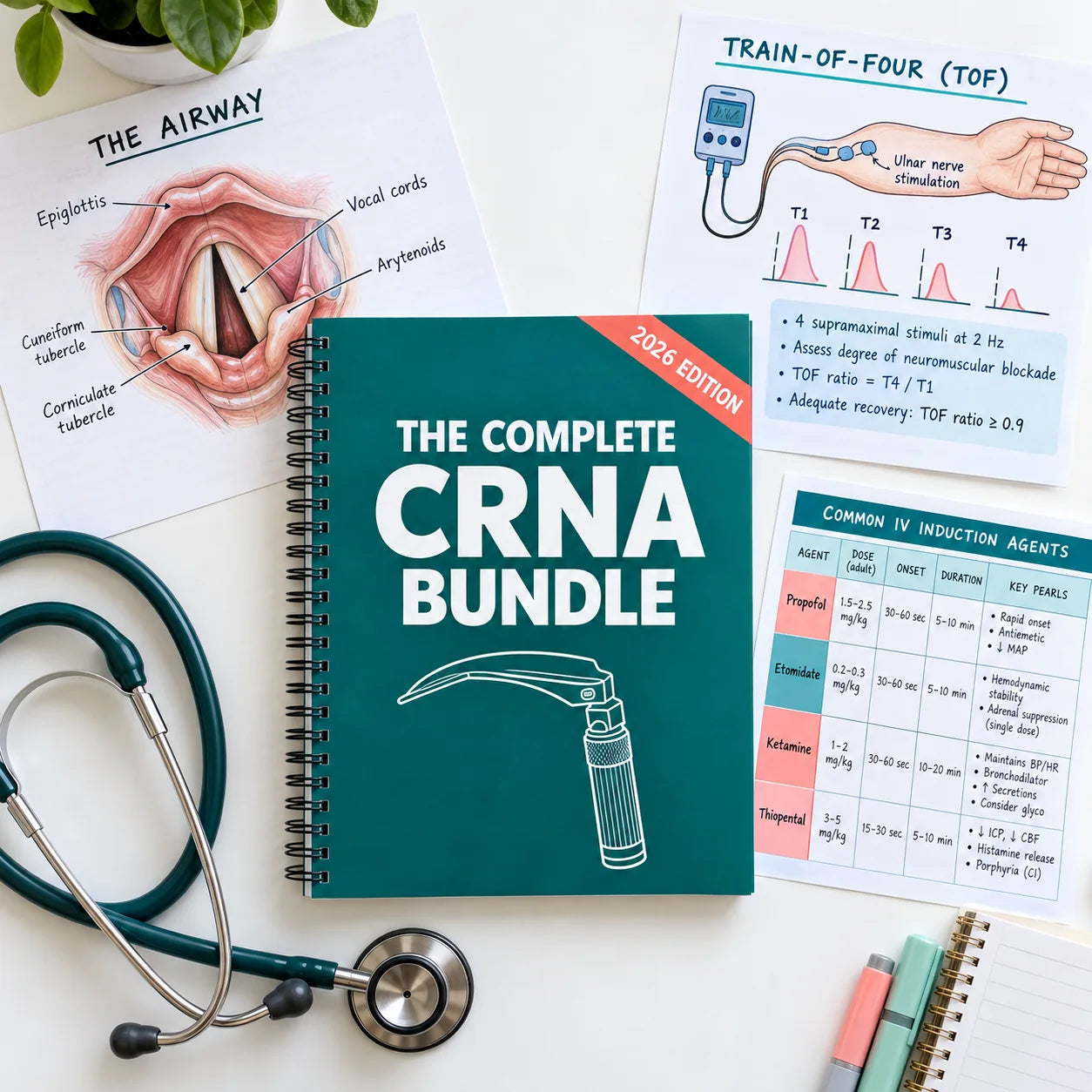
Not notes. A visual system.
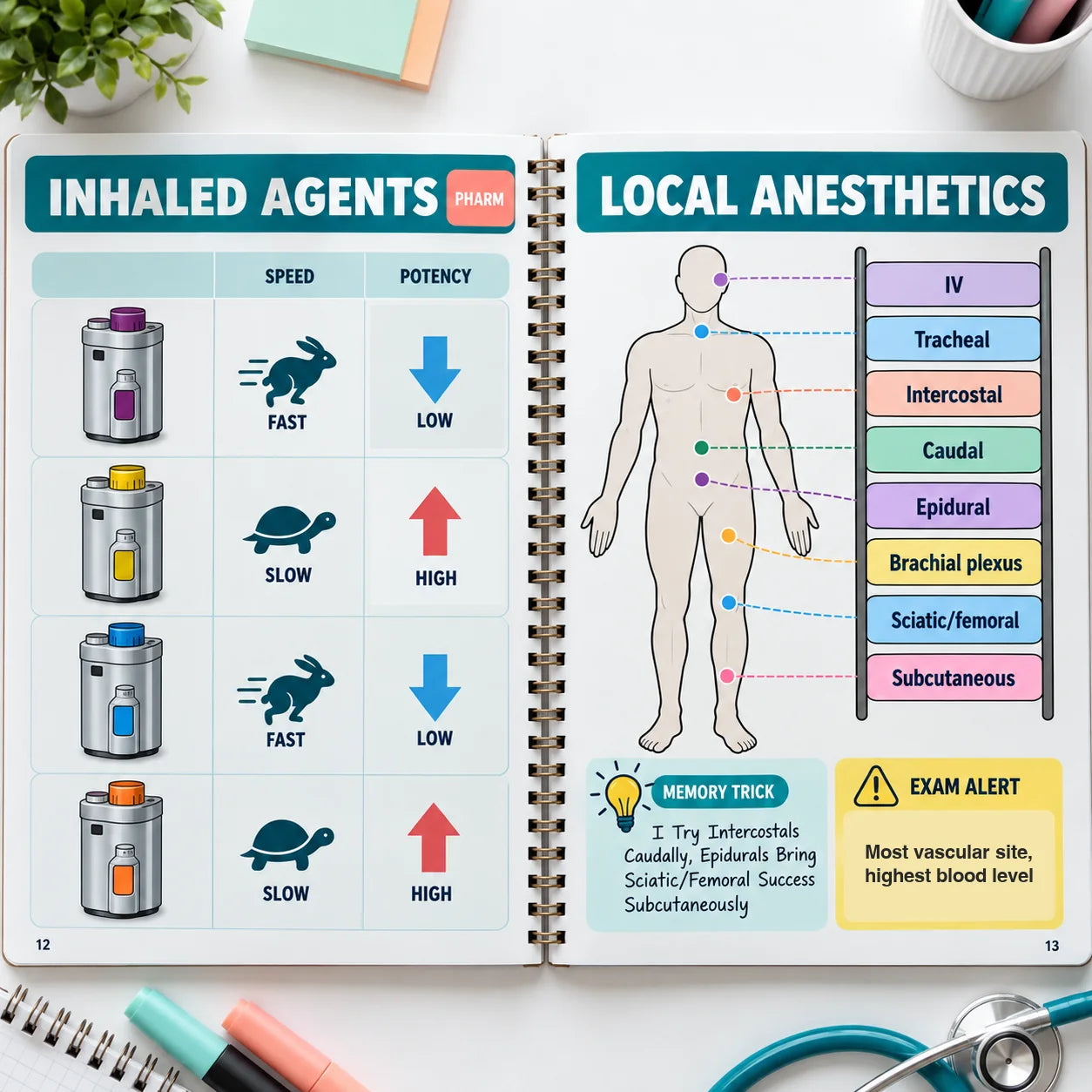
Every spread uses the same five tools, so your brain always knows where to look, even after a long clinical day.
Wherever you are on the path, you start today.
Walk into the interview ready
Admission interviews go deep on vasoactive drips, hemodynamics and ABGs, and seats are few. The pharmacology and the physiology are drawn so you can explain a mechanism out loud, not just recognize it. The bundle goes alongside your ICU experience and your program's requirements. It doesn't replace them.
One page before every case
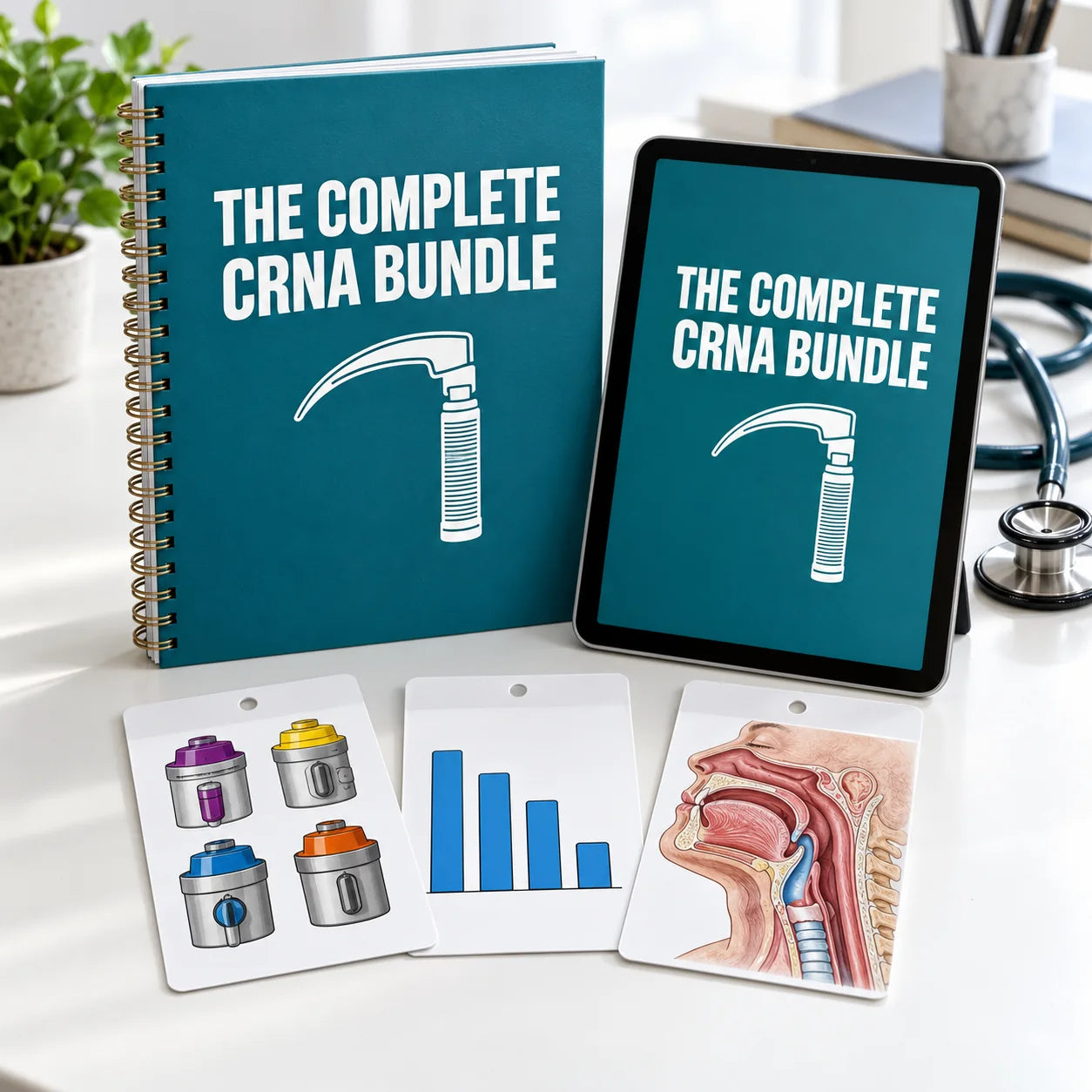
Every topic fits on a short page you can read between lectures or the night before clinicals. Plus the 3 badge cards for your reel: inhaled agents at a glance, neuromuscular blockers & reversal, and airway & emergency algorithms.
Review, don't relearn
24 pages of NCE cram sheets, a 4-week plan and a one-page NCE map tell you what to reread and when to switch to practice questions. It's your review, not your question bank: pair it with a Q-bank and the SEE.
Know the drug. Know the patient. Plan the anesthetic.
In the OR the drug is never the whole answer: the same agent can be right for one patient and wrong for the next, and the NCE asks you to think the same way. So every topic in the bundle follows the same path: the pharmacology or the physics behind it, the physiology and pathophysiology of the patient in front of you, then the anesthetic plan and what to do if it goes wrong.
Know the drug
Mechanism, receptor, onset and offset, interactions: drawn so you see why an agent works the way it does, not a list to memorize. The comparison charts put the look-alikes side by side so you can tell them apart in seconds.
Know the patient
The heart, the lungs, the brain and the kidneys, and what changes in the patient in front of you, from your first OB epidural to your first pediatric induction. Drawn one level deeper than the ICU, where anesthesia needs it.
Plan the anesthetic
Every topic ends on the plan: what you'd choose, what you'd watch, and the algorithm to follow if it goes wrong. The NCE asks you to apply what you know to a patient, and that's how you think at the head of the bed, always inside your program's and your facility's protocols.
Fast on, fast off, finally clear.
Why does one agent put the patient to sleep faster, and let them wake up faster, than another? Here every inhaled agent is drawn on the same chart, so solubility, uptake and emergence stop being abstract words.
- The inhaled agents side by side on one color-coded chart: blood:gas solubility, MAC and what changes MAC
- Exam alert: solubility sets the speed, MAC sets the potency. Don't mix them up.
- The concentration effect and the second gas effect, drawn as one picture
- Uptake, distribution and emergence drawn as one path
- Plus 16 pages of physics & chemistry for anesthesia in their own chapter
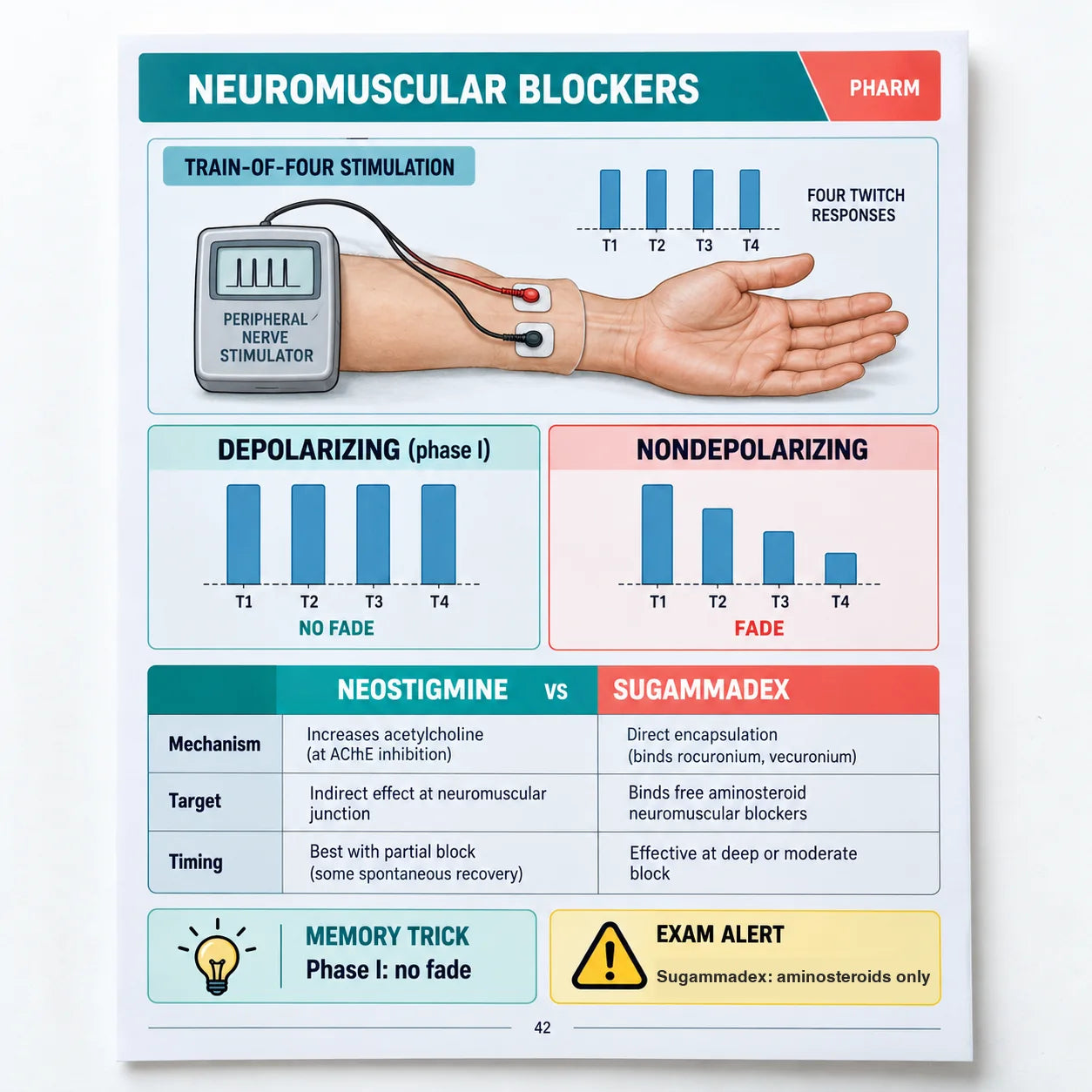
Twitch, fade, reverse: one picture.
Four twitches on the monitor don't mean your patient is ready. Here depolarizing and nondepolarizing blockers are drawn at the receptor and on the train-of-four, so the patterns make sense before you need them.
- Depolarizing vs nondepolarizing blockers side by side, at the receptor
- The train-of-four drawn: what fade looks like, and what it tells you
- Neostigmine vs sugammadex: how each one works, which blockers each can reverse, and why depth of block changes the choice
- Why a quantitative train-of-four ratio sees the fade your eyes miss
- Exam alert: succinylcholine and the nondepolarizers look different on the monitor, and the NCE checks that you know which is which
Where you inject changes everything.
The same local anesthetic behaves differently depending on where it goes. Here the injection sites are ranked on one drawing, and LAST is drawn from the first sign to the rescue, so you know what to watch for and what to reach for.
- Systemic absorption ranked by site on one drawing, from highest to lowest
- Neuraxial and peripheral blocks drawn with the anatomy that matters
- Local anesthetic systemic toxicity (LAST): the signs, airway and seizure control first, lipid emulsion early, following the ASRA checklist
- No doses: for every number, follow your program's teaching and your facility's protocols
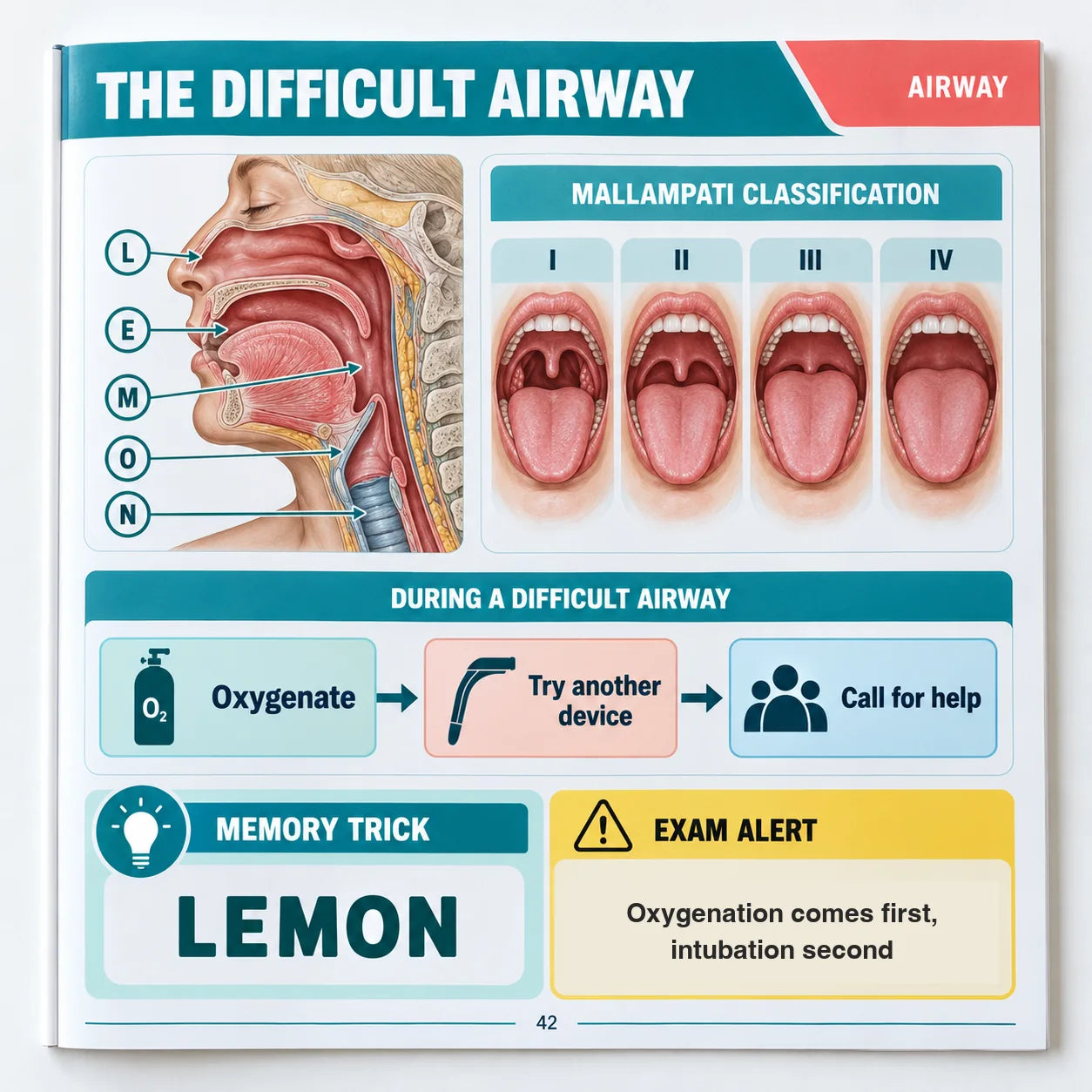
See the difficult airway before induction.
The worst airway is the one you didn't see coming. Here the assessment, the equipment and the algorithm are drawn in the order you use them, so plan B is already in your head before the drugs go in.
- LEMON drawn on one face for laryngoscopy, plus the predictors of difficult mask ventilation and supraglottic airway
- The airway equipment side by side, and when you reach for each
- The difficult airway algorithm drawn step by step
- The difficult airway again in the emergencies chapter, next to MH, LAST and anaphylaxis
When it goes wrong, the page is already in your head.
End-tidal CO2 climbing, a reaction right after a drug goes in, a local anesthetic reaching the bloodstream, an airway that won't cooperate. Here the emergencies are drawn from the first sign to the algorithm, so recognition comes first and the steps follow.
- Malignant hyperthermia: the first signs, stopping the triggers, and dantrolene in the treatment
- LAST: recognizing it, and lipid emulsion in the rescue
- Anaphylaxis under the drapes: when hypotension or bronchospasm is the only sign, and why epinephrine comes first
- The difficult airway: the algorithm when plan A fails
- No doses: always your facility's protocols and emergency resources
The last four weeks before the NCE, on 24 pages.
The agents, blockers, blocks, airway steps and emergencies the NCE asks about most, condensed into cram sheets you can reread between clinicals.
- Inhaled agents and neuromuscular blockers & reversal at a glance
- The difficult airway and the emergencies, one page each
- The room setup on one line: "MS MAID: Machine, Suction, Monitors, Airway, IV, Drugs." The full machine checkout is in chapter 7.
- A 4-week NCE plan: what to review each week, and when to switch to practice questions
- The one-page NCE map: every chapter linked to the areas of the NCE content outline

Your textbooks explain it. These pages show it.
The drawing, the color and the layout are the mnemonic: you remember the page, so you remember the answer.
- Mapped to the current NCE content outline, with a one-page NCE map
- Drawn by a Certified Registered Nurse Anesthetist, CRNA, DNP
- Updated every year; ebook buyers get the new edition free
Inside the bundle.
From physiology to emergencies, in one bundle.
Full table of contents
On your iPad, on your desk, or both.
Instant download, hyperlinked index
Works in GoodNotes, Notability and any PDF app. Free update every year.
Full color, lay-flat, 8.5 × 11
Printed on thick paper with colored tabs, laminated badge cards included. Free US shipping.
150 flashcards and 3 badge cards.
Inhaled and IV agents, neuromuscular blockers, local anesthetics, airway and emergencies: the drawing on one side, the answer on the other. Print them, ring them, or swipe them in GoodNotes before clinicals. The badge cards fit your reel: inhaled agents at a glance, neuromuscular blockers & reversal, and airway & emergency algorithms.
- Printable PDF, 4 per page
- Digital version with hyperlinked index
- Badge cards laminated with the spiral-bound edition
Get 10 real pages, free.
LEMON drawn on one face, the inhaled agents on one chart, the train-of-four and fade, the local anesthetic absorption ladder, and one topic followed from the drug to the patient to the anesthetic plan. Study them after your next clinical day and decide with the pages in your hands.
How it stacks up.
| Feature | This bundle | Review course (from $835) | Online prep program (from $175) | Q-bank app (subscription) |
|---|---|---|---|---|
| Every topic built around a drawing | ✓ | Slides & lectures | Varies | ✗ |
| Every topic from the drug to the patient to the anesthetic plan | ✓ | Varies | Varies | Question by question |
| Mnemonics and memory tricks in every chapter | ✓ | Varies | Varies | Varies |
| Practice questions | Pair with one | Usually included | Varies | ✓ |
| Print + iPad or phone | ✓ | Live or video | Screen | Screen |
| Use it from your first lecture to NCE day | ✓ | Weeks before the exam | Varies | While subscribed |
| Badge cards for clinicals | ✓ | ✗ | ✗ | ✗ |
| Free ebook updates | ✓ | Varies | Varies | While subscribed |
| Mapped to the current NCE content outline | ✓ | Check the date | Check the date | Check the date |
| Price | From $49.99 | From $835 | From $175 | Subscription |
Studying before your next clinical day, not next month.
Pick your format
eBook, spiral-bound or both. Secure checkout, no account to create, no subscription.
Open it anywhere
Your download link arrives by email. Open it in GoodNotes, Notability or any PDF app, or print the pages you need.
The book comes to you
Your full-color spiral-bound copy and laminated badge cards ship free in the US, with tracking.
Everything, one price.
- 356 illustrated pages, 11 chapters, built for the NCE
- Every topic built the same way: know the drug, know the patient, plan the anesthetic
- 56 pages of physiology and pathophysiology, plus 72 on the patient in front of you: OB, pediatric, cardiac, neuro, geriatric and more
- 32 pages of airway management, from LEMON to the algorithm
- 150 printable & digital flashcards
- 3 badge cards for clinicals
- NCE cram sheets with a 4-week plan
- Free yearly update for the ebook
- Free US shipping on spiral-bound
The questions SRNAs ask before buying
Will this be enough to pass the NCE?
It covers the content the NCE draws on, from physiology and pharmacology to airway, equipment and emergencies, with the distinctions the exam keeps asking flagged as exam alerts. But it doesn't include practice questions, and we'd rather tell you up front. Knowing the content and answering questions under time are two different skills, so pair the bundle with a Q-bank and the SEE: the pages help you remember, the questions teach you to apply.
The NCE has a higher passing standard since July 2026. What does that mean for me?
On July 1, 2026 the NBCRNA raised the passing standard. In 2025, 90.5% of the 3,294 first-time takers passed (NBCRNA 2025), but those results came under the old standard, so don't count on the same margin. Study for understanding, not for the minimum. Check the NBCRNA site for the current standard and exam format before you schedule.
Will it help with the SEE?
The Self-Evaluation Exam (SEE) from the NBCRNA is taken during your program and shows you where you stand before the NCE. Use the bundle to review before it, then use your SEE score report to see which areas to reopen: the one-page NCE map points you to the matching chapters. Ask your program when you'll take it.
What does the NCE actually look like?
It's a computer adaptive test: the questions adjust to your answers and the number you get varies, so you can't count your way to a pass. That's why the bundle builds understanding, not recall, and why the one-page NCE map links every chapter to the areas of the current NBCRNA content outline. Check the NBCRNA site for the current length, time and fee before you schedule.
I'm still an ICU nurse. Is it too early?
No. Start with the physiology chapter and the IV and vasoactive drugs: that's what interviews ask you to explain out loud. Keep the anesthesia chapters for later. The same pages follow you into school, through clinicals and to the NCE, so you buy them once.
I didn't pass the NCE the first time. Will this help?
Use your NCE score report to see which areas were weak, then open the matching chapters through the one-page NCE map. Review the content there, then go back to questions. It's a fresh way to see topics you've already read many times.
Will it help with my CRNA school interview?
Yes, it's one of the reasons it exists. Admission interviews often go deep on pharmacology and hemodynamics, and most programs accept only a small share of applicants. The drug chapters and the physiology chapter are drawn so you can explain a mechanism out loud, not just recognize it. It won't replace your ICU experience, but it helps you talk about it with confidence.
My program uses Nagelhout, Barash or Morgan & Mikhail. Will it match?
Yes. It doesn't replace your textbooks: it turns what they explain in long chapters into pages you can see at a glance. The topics are the ones every program covers, so you can read the bundle alongside whichever textbook your faculty assigned, and go back to the textbook for the full detail.
Does it include drug doses?
No, on purpose. Doses depend on the patient, the product and your facility, and they change. The bundle shows how each drug works, how it compares and when you'd reach for it. For every number, follow your program's teaching, current references and your facility's protocols.
Which apps does the ebook work with?
Any PDF app on your iPad, phone or computer: GoodNotes, Notability, Apple Books, Adobe, Xodo. The index is hyperlinked so you can jump between chapters. You can also print any page.
Is the spiral-bound printed in color?
Yes, full color, 8.5 × 11 inches, lay-flat spiral binding, colored tabs, and the 3 badge cards laminated. Ships free in the US.
What if it isn't for me?
Email us within 30 days and we refund you. No questions, no forms.
Can I use my program funds or a scholarship to pay for it?
Many programs, scholarships and employers cover study materials. You get an itemized receipt by email right after checkout, ready to hand in for reimbursement.
Ready to walk into the NCE knowing the drug, the patient and the plan?
356 illustrated pages, 11 chapters, 150 flashcards, 3 badge cards. Instant download. 30-day guarantee.
$49.99 · instant access