The MAP just dropped.
Know your next move.
At 3 a.m. the MAP drifts down and nobody hands you a textbook. 344 pages of numbered illustrations, comparison charts, mnemonics and memory tricks turn hemodynamics, drips, vents and rhythms into pictures you can read at a glance. Every chapter is mapped to the CCRN (Adult) blueprint, so you always know which part of the exam you're studying.
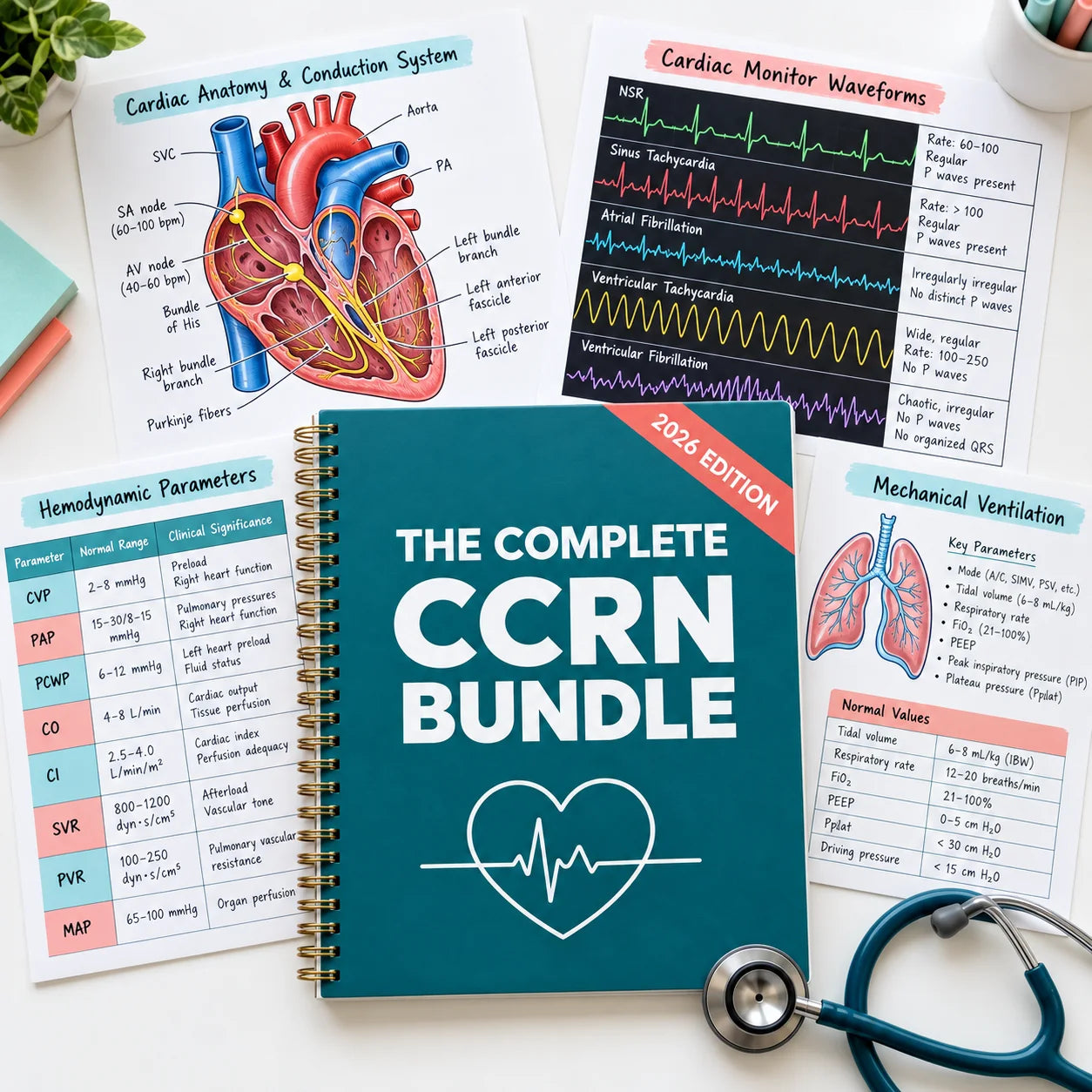
Not notes. A visual system.
Every spread uses the same five tools, so your brain always knows where to look, even after a 12-hour shift.
Whatever shift you're on, you start today.
Make sense of the numbers
Hemodynamics, drips and vent settings drawn so you understand why they move, not just what to chart. Use them on the unit now, and they're your CCRN review the day your hours qualify.
Ten minutes is enough
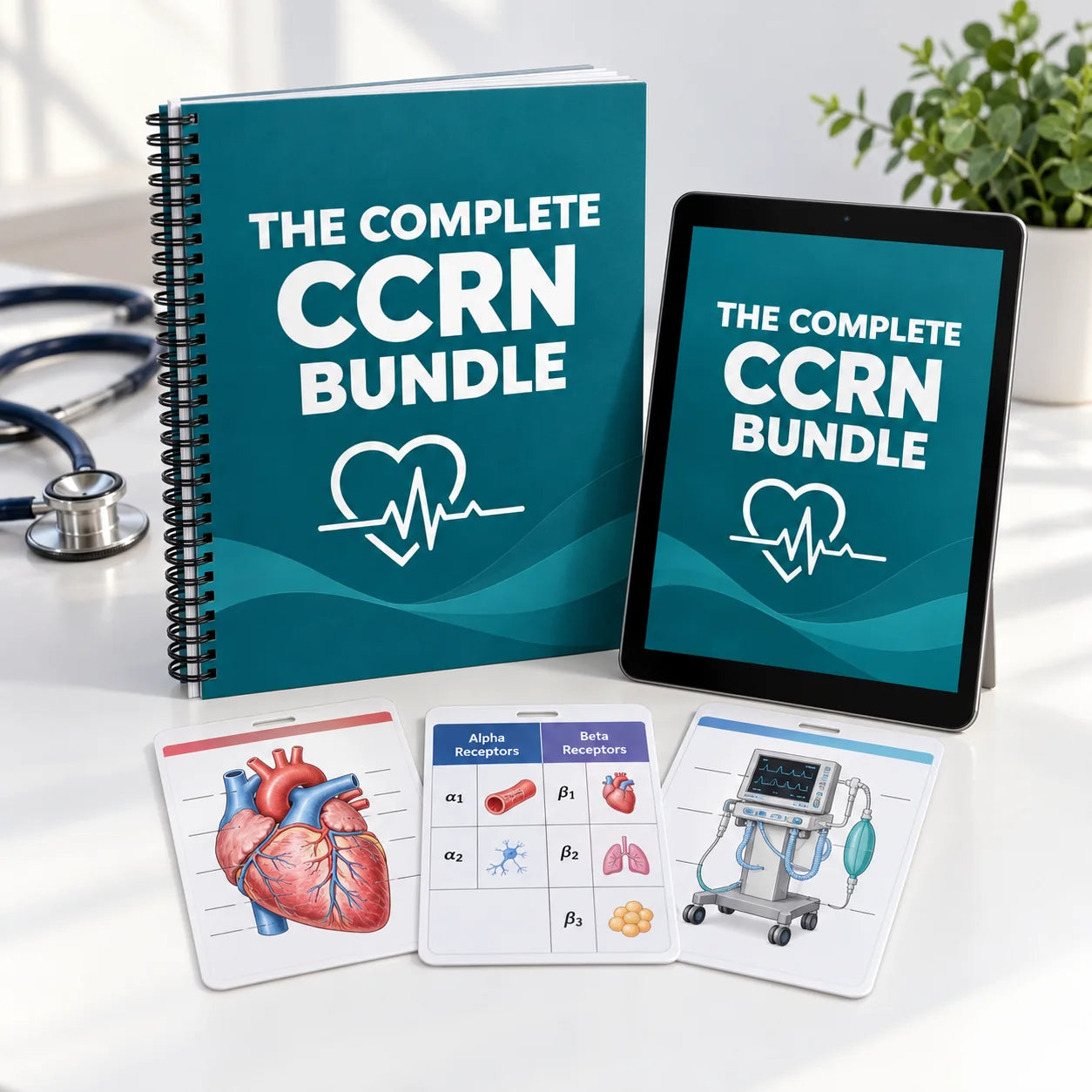
Every topic fits on a short page you can read on a break or the morning after a shift. Plus the 3 badge cards for your reel: vasoactive drips at a glance, shock hemodynamics, and an ABG & vent cheat card.
Walk in certified
Many CRNA programs require or prefer the CCRN, and their interviews dig into the same hemodynamics, drips and vents. The same pages help you prepare for both. Check each program's requirements.
See the number. Name the problem. Know what comes first.
80% of the CCRN is clinical judgment: a patient, a set of findings, and a question that asks you to recognize, prioritize or act. So every topic in the bundle follows the path you already use at the bedside: it starts from the values, gets to the problem, and ends on what comes first. The other 20%, professional caring and ethical practice, gets its own chapter: advocacy and moral agency, caring practices, collaboration, systems thinking, response to diversity, facilitation of learning and clinical inquiry, the other nurse characteristics of the AACN Synergy Model.
See the number
Every clinical topic starts from what you actually see: the monitor, the hemodynamic profile, the gas, the labs. Drawn so you know which values move together and which one to look at first.
Name the problem
From the numbers to the problem: which shock state, which acid-base disorder, which wall of the heart. The comparison charts put the look-alikes side by side so you can tell them apart in seconds.
Know what comes first
Every topic ends on what you do next and what comes first. It's how the CCRN asks its questions, and it's how you already think on the unit.
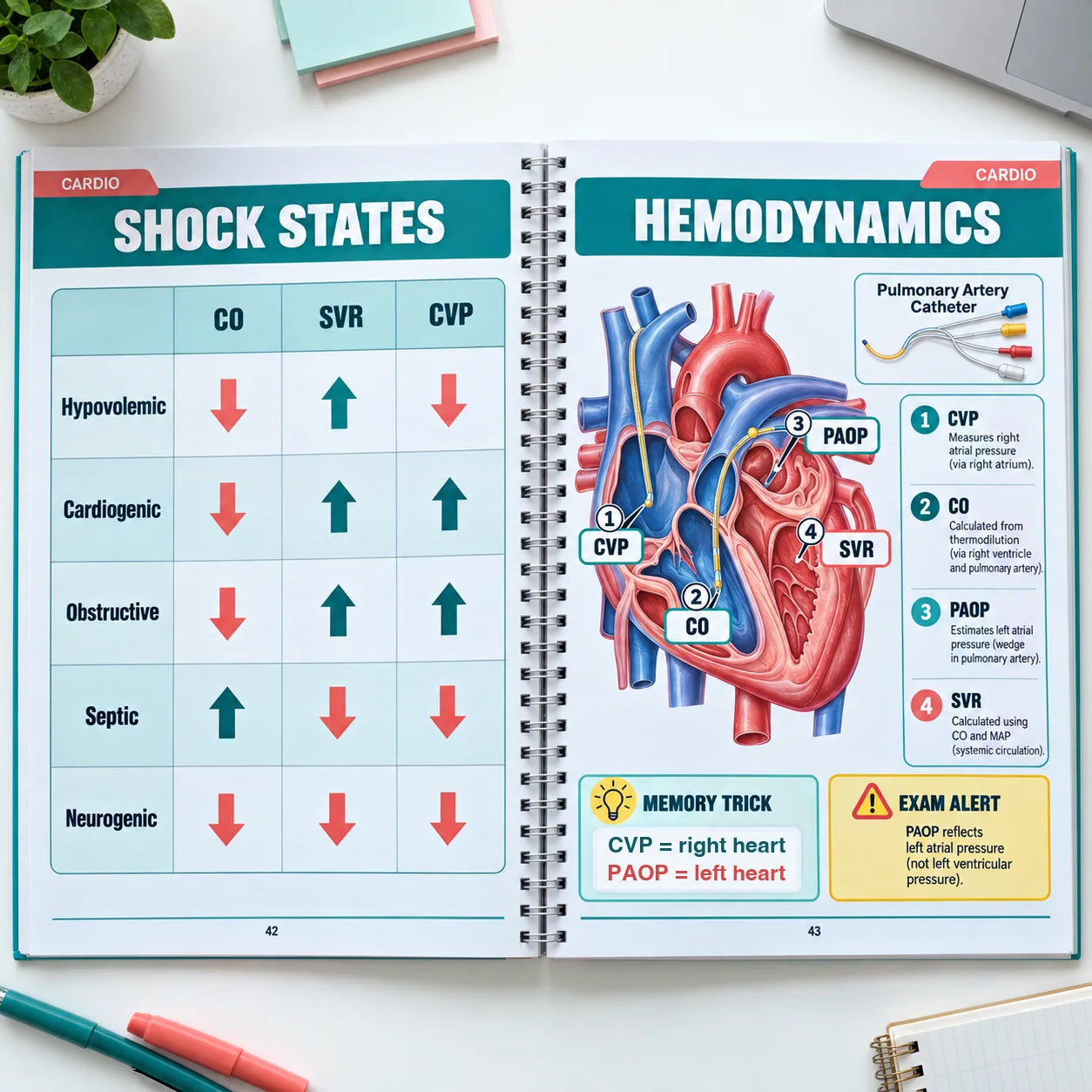
Every shock state on one chart.
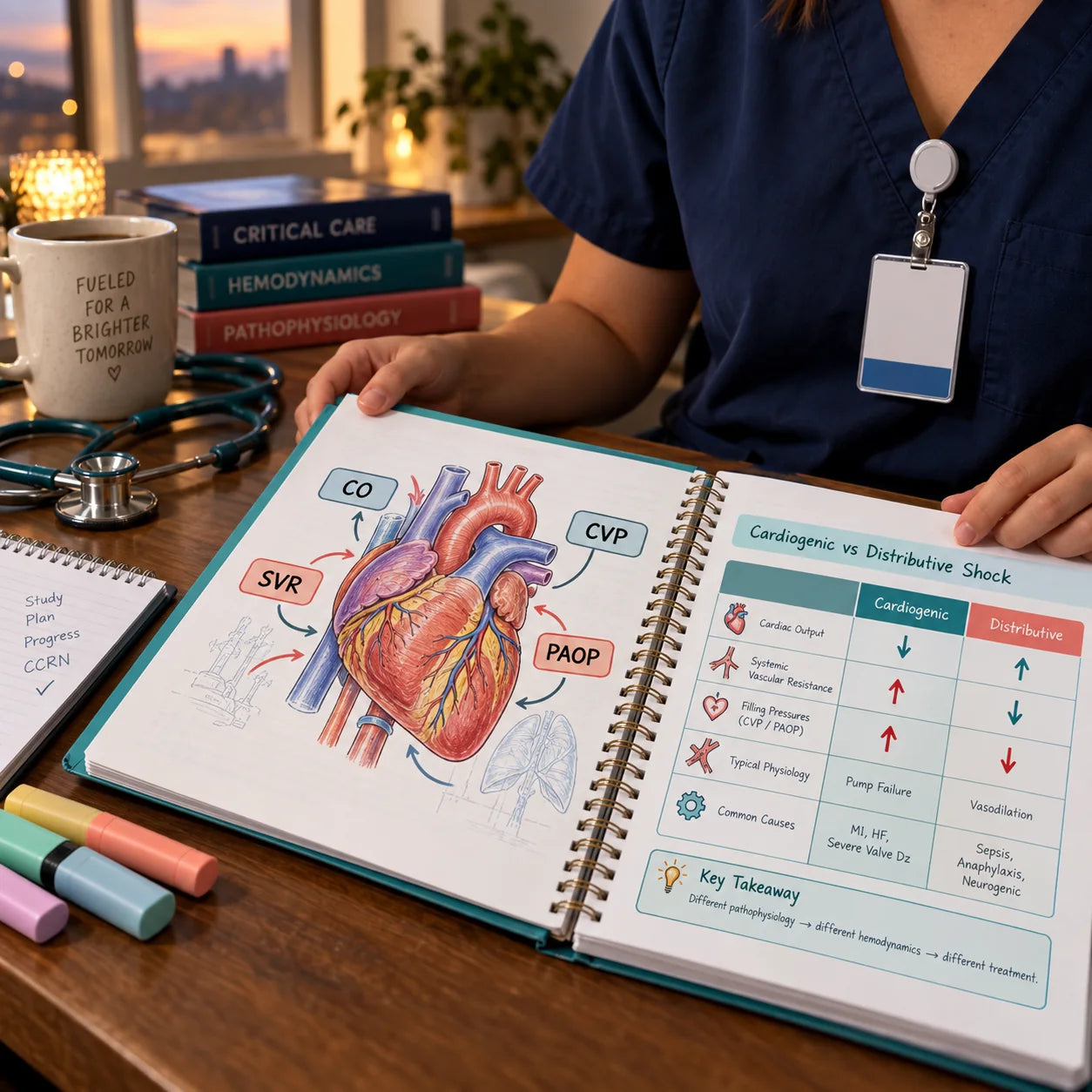
Hypovolemic, cardiogenic, septic: on the monitor they can look alike until you read the whole profile. Here each shock state is one row of the same chart, so you see which way the numbers move and why.
- Hemodynamic parameters drawn on the heart and the circulation, so you know what each one measures
- Hypovolemic, cardiogenic, obstructive and distributive (septic, anaphylactic, neurogenic) shock side by side: CO, SVR, CVP and PAOP
- ACS, heart failure, cardiac surgery and aortic emergencies, plus IABP, Impella, VAD, ECMO and pacemakers: from the numbers to the priority
- Which value to look at first, and what it changes at the bedside
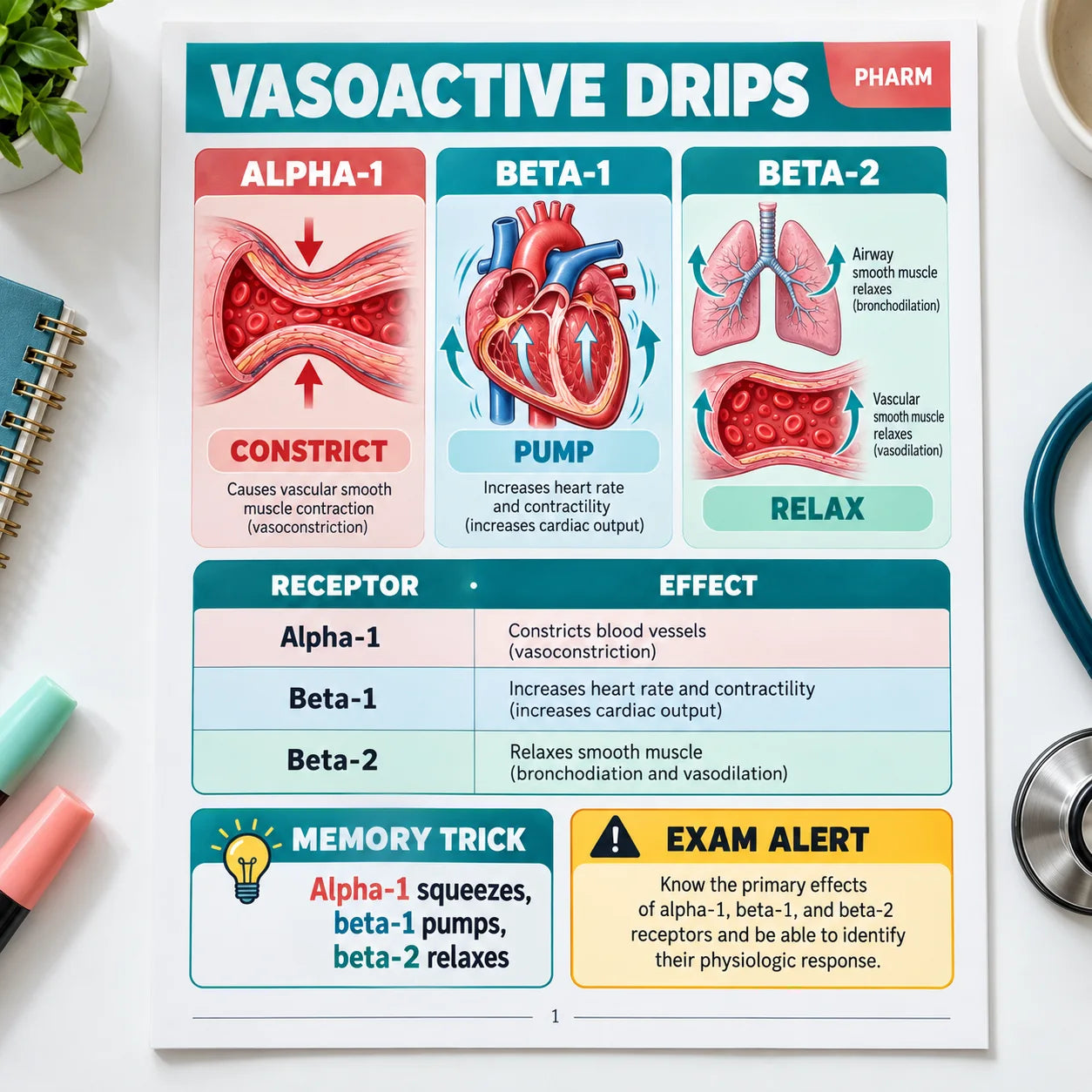
Know the drip by its receptor.
Four pumps running and the next titration is yours. Here every vasoactive is sorted by the receptors it hits, so you know what it does to the pressure, the heart rate and the output before you touch the pump.
- Vasopressors and inotropes sorted by receptor in one chart, plus the two that skip adrenergic receptors: vasopressin and milrinone
- What each drip does to SVR, heart rate and cardiac output
- Sedation, analgesia and paralytics: what to watch and why
- What to assess on every drip. No dose tables: doses come from your unit's protocols and pharmacy
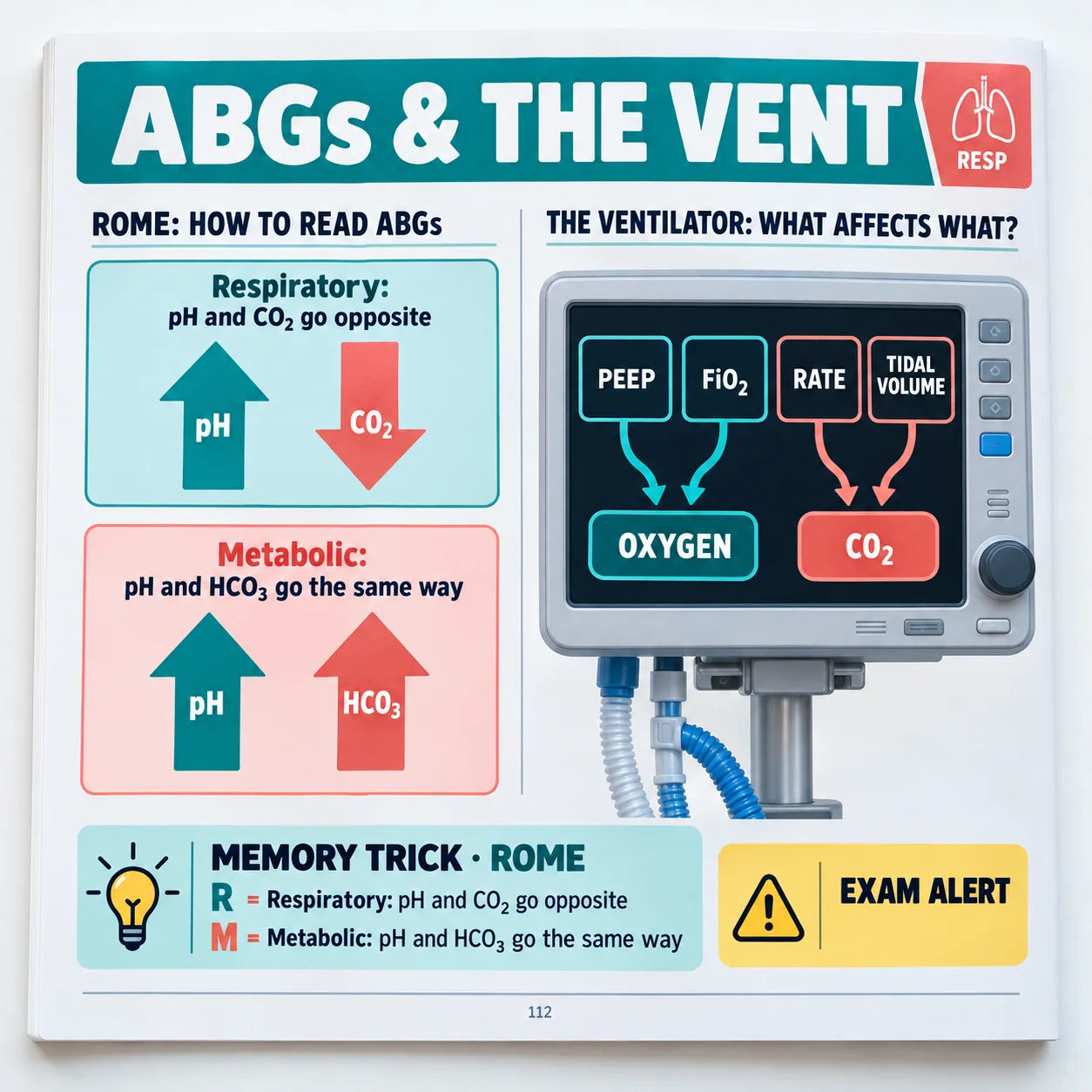
Read the gas. Know which setting fixes it.
The gas comes back and the team looks at you. Here every ABG is read in the same steps, and every vent setting is linked to the number it changes, so you know which knob fixes which value.
- ABG interpretation in the same steps every time, compensation included
- Vent modes drawn and compared side by side
- "PEEP and FiO2 for oxygen, rate and tidal volume for CO2." Exam alert: in ARDS, lung-protective volumes stay put, so expect rate changes and some permissive hypercapnia
- ARDS and acute respiratory failure, from the numbers to the priority
From the strip to the wall to the artery.
A new ST change right at shift change. Here the 12-lead is drawn as a map of the heart, lead by lead, so you go from the strip to the wall to the artery, and from the rhythm to what you do next.
- The 12-lead drawn as a map: which leads look at which wall
- Dysrhythmias compared side by side, strip next to strip
- From the rhythm to the priority: what to assess, what to do first
- Part of the 64-page Cardiovascular chapter
Catch the pressure before it climbs.
Neuro changes are quiet until they aren't. Here intracranial pressure, stroke and the neuro assessment are drawn step by step, so you recognize the warning signs early and know what comes first.
- Intracranial and cerebral perfusion pressure drawn (CPP = MAP − ICP): what raises ICP and the early signs, starting with a change in level of consciousness
- Ischemic vs hemorrhagic stroke side by side
- The neuro assessment in the same order every time
- Seizures, brain and spinal cord injury, subarachnoid hemorrhage, Guillain-Barré and myasthenia, brain death: from the signs to the priority
- "Cushing's triad: rising systolic BP with a widening pulse pressure, bradycardia, irregular breathing." Flagged as an exam alert: it's a late sign, so the chapter teaches the earlier ones first
The last weeks before the CCRN, on 20 pages.
The hemodynamics, drips, gases and rhythms the CCRN asks about most, condensed into cram sheets you can reread between shifts.
- Every shock state and every vasoactive on one page
- ABGs, vent settings and the 12-lead territories at a glance
- The Synergy Model and professional caring on one page
- A 4-week CCRN plan built around your shifts: what to review each week, and when to switch to practice questions
- The one-page CCRN blueprint map: every chapter linked to the CCRN (Adult) blueprint
Your review book explains it. These pages show it.
The drawing, the color and the layout are the mnemonic: you remember the page, so you remember the answer.
- Mapped to the CCRN (Adult) blueprint, with a one-page blueprint map
- Drawn by a critical care nurse, BSN, RN, CCRN
- Updated every year; ebook buyers get the new edition free
Inside the bundle.
The whole blueprint, in one bundle.
Full table of contents
On your iPad, on your desk, or both.
Instant download, hyperlinked index
Works in GoodNotes, Notability and any PDF app. Free update every year.
Full color, lay-flat, 8.5 × 11
Printed on thick paper with colored tabs, laminated badge cards included. Free US shipping.
120 flashcards and 3 badge cards.
Hemodynamics, drips, ABGs, rhythms and every body system: the drawing on one side, the answer on the other. Print them, ring them, or swipe them in GoodNotes on your break. The badge cards fit your reel: vasoactive drips at a glance, shock hemodynamics, and an ABG & vent cheat card.
- Printable PDF, 4 per page
- Digital version with hyperlinked index
- Badge cards laminated with the spiral-bound edition
Get 10 real pages, free.
Every shock state on one chart, alpha vs beta for the drips, an ABG read step by step, the vent settings that fix each number, the 12-lead territories, and one patient followed from the number to the problem to the priority. Study them after your next shift and decide with the pages in your hands.
How it stacks up.
| Feature | This bundle | Review book | Review course | Q-bank app |
|---|---|---|---|---|
| Every topic built around a drawing | ✓ | Some figures | Mostly video & slides | ✗ |
| Every topic from the number to the priority | ✓ | Varies | Varies | Question by question |
| Mnemonics and memory tricks in every chapter | ✓ | Varies | Varies | Varies |
| Practice questions | Pair with one | ✓ | ✓ | ✓ (timed) |
| Print + iPad | ✓ | Print or ebook | Screen | Screen |
| Badge cards for your shift | ✓ | ✗ | Rarely | ✗ |
| Free ebook updates | ✓ | New edition $ | Varies | With subscription |
| Price | $29.99 | From $45 | From $199 | From $20.99/month |
Studying after your next shift, not next month.
Pick your format
eBook, spiral-bound or both. Secure checkout, no account to create, no subscription.
Open it anywhere
Your download link arrives by email. Open it in GoodNotes, Notability or any PDF app, or print the pages you need.
The book comes to you
Your full-color spiral-bound copy and laminated badge cards ship free in the US, with tracking.
Everything, one price.
- 344 illustrated pages, 11 chapters, mapped to the CCRN (Adult) blueprint
- Every topic built the same way: see the number, name the problem, know what comes first
- 64 pages of cardiovascular & hemodynamics, the 12-lead included
- 44 pages of ABGs & ventilators, every setting linked to the number it changes
- 120 printable & digital flashcards
- 3 badge cards for your shift
- CCRN cram sheets with a 4-week plan
- Free yearly update for the ebook
- Free US shipping on spiral-bound
The questions nurses ask before buying
Will this be enough to pass the CCRN?
It covers the content the CCRN draws on: clinical judgment across every body system in the blueprint, and professional caring and ethical practice through the Synergy Model, with the distinctions the exam keeps asking flagged as exam alerts. But the CCRN is 150 questions in 3 hours, most of them clinical scenarios, so you also need practice answering under time. Pair the bundle with a question bank: the pages help you remember, the questions teach you to apply.
Does it include practice questions?
No, and we'd rather tell you up front. The bundle is the content: illustrated, organized and easy to review between shifts. For timed practice, pair it with a question bank app or the practice resources listed on the AACN site. The two work together: pages to remember, questions to apply.
I already have a review book or a course. Do I need this?
Keep them. A course explains, a book goes deep, a question bank tests you. This is the part you reread: every topic on a page you can picture during the exam.
Do I have enough clinical hours to sit the exam?
You need a current, unencumbered US RN or APRN license and a set number of direct-care hours with acutely or critically ill adult patients: AACN offers a two-year option (1,750 hours, 875 of them in the most recent year) and a five-year option (2,000 hours, 144 in the most recent year). The current rules on the AACN site are the ones that count: check them before you book your date.
I work three 12s. When am I supposed to study?
That's who we built it for. Every topic fits on a short page you can get through in about ten minutes, on a break or the morning after a shift. The badge cards keep the drips, the shock profiles and the gases in front of you, and the 4-week plan in the cram sheets is built around a shift schedule, not a school semester.
It's been years since nursing school. Can I keep up?
Yes, that's who the drawings are for. Every page starts from the picture and the numbers you already see on the unit, then explains the physiology behind them without assuming you remember your pathophysiology class.
I've been in the ICU for years. Is this too basic?
The pages start from what you already see on the unit, then go to the distinctions the CCRN tests: the look-alike shock profiles, the drip that drops the pressure you expected it to raise, the late sign versus the early one. Experienced nurses usually skim the familiar pages and spend their time on the exam alerts and the body systems they don't see every shift.
My CCRN is in a few weeks. Is it too late?
No. Start with the cram sheets and the one-page CCRN blueprint map, use the exam alerts in each chapter to find your weak spots, and follow the 4-week plan: it tells you what to review each week and when to switch to practice questions.
I'm retaking the CCRN. Will this help?
Yes. Start from your score report: it shows how you did in each area of the blueprint. Reopen the chapters behind your weakest one, drill practice questions on it, and finish with the cram sheets the week before. Check the AACN site for the current retake rules.
Will it help with the PCCN, CCRN-K or CCRN-Pedi?
The bundle is written for the CCRN (Adult). The PCCN covers adult patients too, so a good part of the physiology overlaps, but the focus and the blueprint are different. The CCRN-Pedi is built around pediatric patients, so the overlap there is smaller. The CCRN-K, for nurses in indirect-care roles like educators and managers, has its own eligibility and test plan. If you're taking one of those, check its test plan on the AACN site and use the chapters that match.
I'm applying to CRNA school. Is it useful?
Yes. Many CRNA programs look for the CCRN, and the interviews dig into the same hemodynamics, vasoactives and vent physiology. Studying for one prepares you for the other. Requirements vary by program, so check each one you apply to.
Will my hospital pay a differential for the CCRN?
It depends on your hospital. Some pay an hourly differential, some a one-time bonus, some reimburse the exam fee, and some do none of these. Magnet hospitals in particular value certified nurses. Ask your manager or HR before you book the exam: they may cover part of the cost, and some hospitals reimburse study materials too. Your order confirmation works as a receipt.
Can I use it on the unit?
The badge cards and the quick-reference pages are made for your locker and your reel. But it's a study guide, not a clinical manual: always follow the provider's orders, your unit's protocols and your pharmacy.
Is it up to date?
Yes. This is the 2026 edition, mapped to the current AACN CCRN (Adult) exam blueprint. We update it every year, and ebook buyers get the new edition free.
Which apps does the ebook work with?
Any PDF app: GoodNotes, Notability, Apple Books, Adobe, Xodo. The index is hyperlinked so you can jump between chapters. You can also print any page.
Is the spiral-bound printed in color?
Yes, full color, 8.5 × 11 inches, lay-flat spiral binding, colored tabs, and the 3 badge cards laminated. Ships free in the US.
What if it isn't for me?
Email us within 30 days and we refund you. No questions, no forms.
Ready to walk into the CCRN knowing your next move?
344 illustrated pages, 11 chapters, 120 flashcards, 3 badge cards. Instant download. 30-day guarantee.
$29.99 · instant access